


That "Genuine Leather" stamp on your favourite handbag is often a warning sign rather than a seal of quality. It's a frustrating reality that many shoppers, misled by vague marketing, discover their expensive purchases peeling or cracking just as they're beginning to settle into them. In a global market for full grain leather expected to reach $22.19 billion in 2026, the distinction between high-street mass production and true luxury has never been more vital for the discerning connoisseur.
We understand that choosing a piece like our Fonteyn or Maya handbag is a significant emotional and financial commitment; we're delighted to assist you in making these choices with confidence. You'll soon discover why full grain leather is the only material that truly rewards its owner, developing a unique patina whilst maintaining its structural integrity for decades. This guide explores how to identify superior hides, the impact of the 2026 LWG Sustainability System, and how to ensure your wardrobe is built on a foundation of genuine, enduring excellence that transcends fleeting trends.
Key Takeaways
- Understand the structural superiority of full grain leather and why its intact vertical fibres ensure your accessories withstand the test of time.
- Look beyond the "Genuine Leather" label to distinguish between high-grade hides and the inferior, corrected-grain alternatives often found in mass-market boutiques.
- Master practical tests to identify authentic pore patterns and natural variations that signify a hide of the highest calibre.
- Discover how the meticulous sourcing of European bovine hides creates the foundation for enduring icons like our Odette and Fonteyn handbags.
- Learn how to care for your investment so it develops a rich, personalised patina whilst maintaining its elegant, structured silhouette for decades.
What is Full Grain Leather? The Pinnacle of Luxury Material
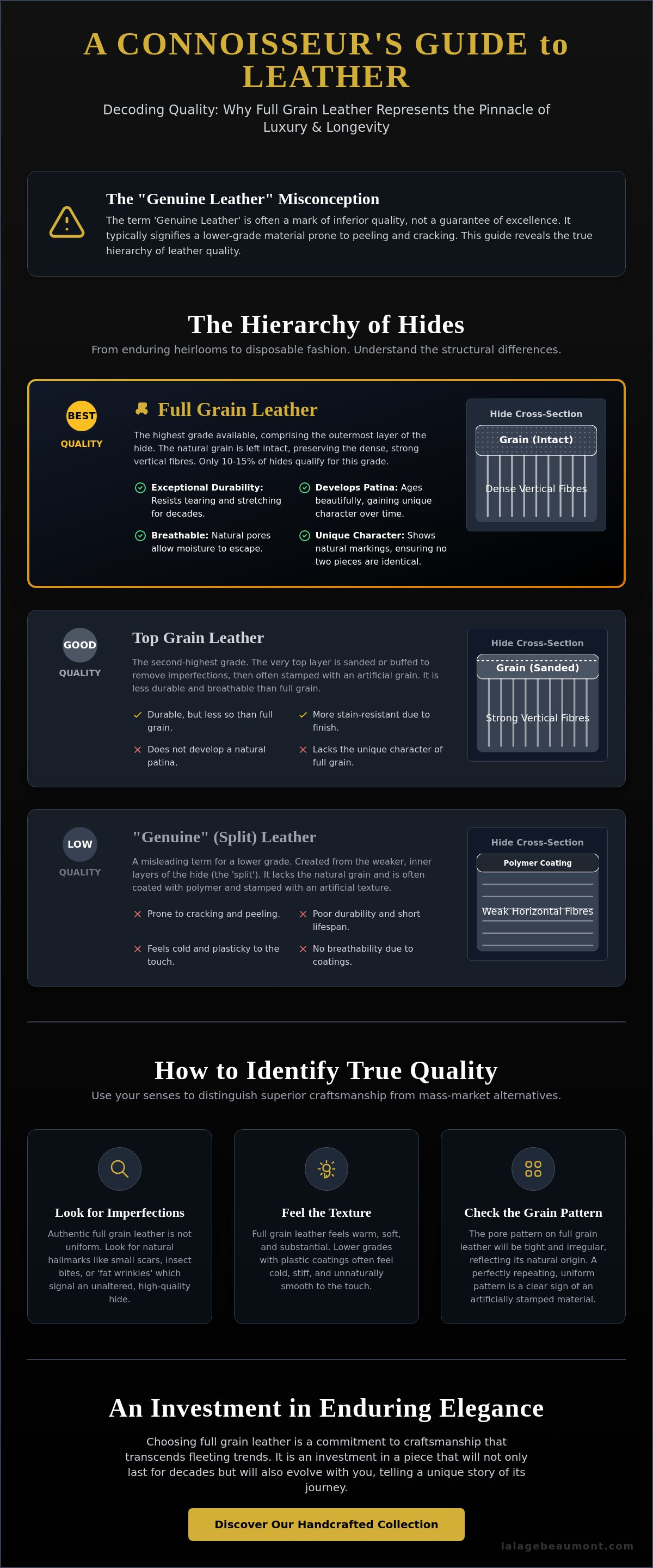
Full grain leather isn't just a label; it's a testament to the hide's natural history. It represents the outermost layer of the bovine hide, left completely intact. Whilst mass-market fashion often relies on "corrected" surfaces, What is Full Grain Leather? is defined by its refusal to hide. It hasn't been sanded, buffed, or snuffed to remove the natural hallmarks of the animal's life. This lack of mechanical processing makes it remarkably rare. Only the finest 10% to 15% of hides possess a surface clear enough to be used for full grain production. Most skins are marred by significant scarring or insect bites, requiring them to be sanded down and stamped with an artificial grain. In contrast, full grain leather preserves the original grain pattern, ensuring each piece remains as nature intended.
Understanding the Hide’s Natural Surface
The secret to its longevity lies in the epidermis. This top layer contains the highest density of protein fibres, which are tightly interwoven in a vertical orientation. By leaving this structure undisturbed, the material retains its maximum tensile strength and natural breathability. Full grain leather is the only grade that retains the complete fibre density of the hide. Because the pores aren't sealed by heavy pigments or synthetic coatings, the leather can "breathe." This allows it to adjust to temperature and resist moisture more effectively than processed, corrected alternatives that often feel cold or plasticky to the touch.
Why Full Grain is the Choice of Connoisseurs
For those who appreciate the concept of "Slow Luxury," the appeal lies in the material's unique character. No two hides are identical. Small "fat wrinkles" or subtle variations in pore pattern ensure that every item is a one-off piece. This authenticity is reflected in the "hand-feel" of the leather, which is soft, warm, and develops a richer texture over time. It's a living material that responds to its environment and the way it's handled by its owner.
We're delighted to work with these premium materials to create our collection of handcrafted leather handbags. When you hold a bag made from this grade, you aren't just holding a product; you're holding a piece of heritage. The minimal processing allows the natural oils to move through the fibres, ensuring the leather doesn't crack but instead grows more beautiful with age. It's a choice for those who value integrity and wish for their accessories to tell a story of quality that lasts for decades. Investing in full grain leather is a commitment to craftsmanship that transcends the fleeting nature of seasonal trends.
The Anatomy of an Investment: Why Full Grain Surpasses Other Grades
Choosing a luxury accessory is an exercise in discerning the permanent from the ephemeral. Whilst mass-market brands often prioritise a flawless, uniform appearance through heavy processing, the true value of full grain leather lies in its internal architecture. At the microscopic level, the fibres at the very top of the hide are densely packed and oriented vertically. This biological arrangement provides an extraordinary level of tensile strength that "split" or "bonded" leathers simply cannot replicate. In those lower grades, the fibres are horizontal or, in the case of bonded leather, merely scraps held together by filler and polyurethane.
The Structural Integrity of the Fibres
These cross-linked protein fibres at the hide's surface act as a natural shield against tearing and stretching. This is the primary reason why high-quality leather does not "peel" or flake over time. When you compare this to the truth about PU leather, the durability gap becomes startlingly clear. Synthetic materials rely on a plastic coating over a fabric base; once that surface is nicked, the entire structure begins to disintegrate. Full grain remains resilient because the strength is inherent to the material itself, not a superficial layer.
A common misconception is that this grade must always be heavy or thick. In reality, master artisans can split the hide to various weights to suit different designs, from a structured Odette handbag to a more delicate wallet, whilst retaining that crucial grain integrity. When paired with vegetable tanning, which uses natural tannins from bark and leaves, the result is a material that is both robust and environmentally conscious. This traditional method ensures the leather remains a "living" material, capable of adapting to its owner's lifestyle.
Breathability and the Development of Patina
The most enchanting quality of full grain leather is its ability to age with grace. Because it remains breathable and unsealed by plastic coatings, it absorbs the oils from your hands and the subtle influences of its environment. This process creates a "patina," a soft, lustrous sheen that deepens the leather's colour and character over time. Identifying Authentic Quality involves looking for this potential; a bag that looks "perfect" and plasticky on day one will only ever look worse as it wears.
A full grain piece is a companion for a lifetime. It transforms from a simple purchase into a unique heirloom that carries a history of your travels and events. If you are seeking a piece that promises this level of longevity, we would be delighted to welcome you to explore our collection of luxury handbags, where every hide is selected for its ability to grow more beautiful with every passing year.
Debunking the "Genuine Leather" Myth: A Guide to Quality Grades
The term "Genuine Leather" is perhaps the most successful piece of misdirection in the fashion industry. To the uninitiated, it sounds like a promise of authenticity; to the connoisseur, it acts as a warning. In reality, "Genuine" is often used to describe the third or fourth grade of leather, usually comprised of the leftover split layers after the top surface has been removed. It lacks the natural strength we discussed previously, relying instead on heavy pigments and artificial textures to mimic a premium look. When you see this stamp, you're looking at a material that's been stripped of its soul and replaces quality with a clever marketing label.
The Truth About "Genuine" and "Bonded" Materials
If "Genuine" leather is the floor of the industry, bonded leather is the basement. Much like particle board in the furniture world, bonded leather is created by shredding leather scraps and bonding them together with polyurethane or latex. These materials often contain as little as 10% to 20% actual leather fibres. The result is a product that feels cold and plasticky, with an environmental cost that's often overlooked. Because these items typically fail within 12 to 24 months, they contribute significantly to landfill waste, contrasting sharply with the "Slow Luxury" ethos of a piece that's designed to last decades. Avoiding the "plastic" feel of these heavily finished leathers is the first step in building a sustainable, high-quality wardrobe.
Top Grain vs Full Grain: The Subtle Distinction
Top grain leather occupies the middle ground. Whilst it's technically a higher grade than "Genuine," it undergoes a process called "buffing" or sanding. This removes the very top layer of the hide to erase natural markings, such as small scars or wrinkles. Whilst some designers prefer this for its uniform, blemish-free appearance, the process compromises the hide's natural integrity. By sanding away the toughest fibres, the leather becomes thinner and more prone to stretching over time.
At Lalage Beaumont, we favour the unadulterated character of full grain leather. Top grain often requires a heavy topcoat of sealant to protect the sanded surface, which prevents the leather from aging naturally. A full grain piece, however, responds to your daily behaviour. It softens where it's held and deepens in colour where it's exposed to the sun. This "break-in" period is a hallmark of quality. You'll find that our handbags, such as the Fonteyn or the Coppelia, don't just endure; they evolve. They become a reflection of your own style rather than a static, mass-produced object. Choosing full grain leather ensures you're investing in a material that values the hide's history rather than trying to erase it.
Identifying Authentic Quality: How to Spot Full Grain Leather whilst Shopping
Distinguishing between a mass-produced imitation and a genuine investment piece requires a return to the senses. Whilst digital browsing offers inspiration, the true test of full grain leather occurs in the hands. When you're standing in a boutique, you have a unique opportunity to look past the marketing labels and examine the biological evidence of quality. Authentic hides don't hide their history; they celebrate it through subtle variations that no machine can perfectly replicate.
Visual Cues: Pores, Scars, and Natural Imperfections
A surface that appears flawlessly uniform is often the first sign of a corrected or synthetic finish. Because full grain is the outermost layer of the hide, it should retain visible "hair follicles" or tiny pores. If you examine the leather closely under a bright light, you should see a slightly irregular pattern. Look for "fat wrinkles" or very small, healed scars. These aren't defects; they're the hallmark of a hide that hasn't been sanded down. Whilst luxury suede offers a different, velvety tactile experience, it shares this same requirement for an authentic, high-quality origin. In full grain, the presence of these natural markings confirms that the structural integrity of the grain remains fully intact.
The Sensory Experience: Scent and Texture
Your sense of smell is a powerful tool for detection. High-quality, traditionally tanned leather possesses a rich, earthy, and slightly sweet aroma. If a bag emits a sharp, chemical, or plasticky scent, it's likely been treated with heavy synthetic topcoats or is a lower grade altogether. The "new car smell" many associate with leather is often a laboratory-created fragrance used to mask inferior materials.
Texture and temperature provide further clues. Full grain leather feels warm to the touch because it's a natural, porous material. Synthetic alternatives often feel unnaturally cold or "clammy." You can also perform two subtle physical tests:
- The Scratch Test: Lightly run a fingernail over an inconspicuous area. On true full grain, this will leave a slight pale mark that can be easily buffed away with the warmth of your thumb as the natural oils redistribute.
- The Water Drop Test: If permissible, a single tiny drop of water on an unfinished edge will be slowly absorbed by the pores. On corrected or bonded leather, the water will simply bead and roll off the plastic sealant.
The "pull-up" effect is another sign of excellence, where folding the leather causes the oils to migrate, creating a temporary, beautiful lightening of the colour. We would be delighted to welcome you to our London boutiques to experience these textures and aromas in person. There is no substitute for the tactile confidence gained by handling a masterfully crafted handbag. If you would like to see how these natural characteristics define our latest collections, we invite you to explore our handcrafted handbags and discover the difference that authentic material makes.
Handcrafted Elegance: How Lalage Beaumont Utilises Full Grain Leather
The Odette and Fonteyn bags are more than just accessories; they're studies in the architectural potential of full grain leather. Whilst many luxury houses rely on internal plastic stiffeners to maintain a bag's silhouette, we rely on the inherent strength of the material itself. Because the vertical protein fibres remain intact, the leather possesses a natural firmness that allows for the sharp, clean lines of our most iconic designs. This structural integrity is essential for a bag intended to be a lifelong companion, ensuring it maintains its elegant form through years of frequent use.
We're delighted to source our hides from a select few European tanneries that meet the rigorous 2026 LWG Sustainability System standards. These premium bovine hides are placed in the hands of master artisans in Italy and Spain who specialise in working with robust, high-grade materials. These craftsmen utilise traditional hand-stitching techniques that have been perfected over generations. This marriage of continental artistry and our "Made in Britain" ethos ensures that every piece leaving our London boutique is a masterpiece of enduring quality.
From Tannery to Boutique: Our Sourcing Philosophy
Ethical responsibility is at the heart of our creative process. We're delighted to partner with tanneries that prioritise traditional vegetable tanning, a method that avoids harsh chromium salts in favour of natural extracts from bark and leaves. This process isn't just better for the environment; it's what allows the leather to breathe and develop that coveted patina. This commitment to "slow luxury" ensures that your investment piece is as sustainable as it is beautiful. Our collection of tailored coats and clothing is designed with this same aesthetic in mind, offering a cohesive wardrobe for the woman who values substance over fleeting trends.
The Odette and Beyond: Timeless Bags for the Modern Wardrobe
The natural firmness of full grain leather is what gives the Odette bag its signature structured shape, making it a favourite choice for the most prestigious events on the British social calendar. Whether you're attending a spring wedding or preparing for Royal Ascot, these bags provide a polished finishing touch that doesn't wilt or lose its form in a crowded marquee. They're designed to be as dependable as they're elegant, serving as a reliable partner for your most significant life events.
If you're looking for a piece that truly defines British luxury and traditional craftsmanship, we would be delighted to assist you in finding your perfect match. We invite you to explore our full collection of handcrafted handbags and experience the unparalleled quality of authentic materials for yourself. Each bag is a testament to the idea that true luxury isn't just seen; it's felt in the weight and texture of a material that only grows more beautiful with time.
Embracing a Future of Timeless Style
Choosing a superior hide is an act of discerning taste that prioritises substance over superficiality. You've now learnt to look past the deceptive "Genuine Leather" stamps and identify the natural pores and warm textures that define a truly luxurious material. These pieces aren't just accessories; they're enduring companions that will develop a unique history through their patina, as we've explored throughout this guide.
Every handbag in our collection is handcrafted by skilled artisans in Italy and Spain. This ensures that the structural integrity of the hide is matched by impeccable workmanship, resulting in items designed for a lifetime of elegance. We would be delighted to welcome you to our London boutiques to experience the quality of our full grain leather handbags in person. Our expert team is ready to assist you in selecting an investment piece that reflects your personal style and commitment to quality. We look forward to helping you find a companion that grows more beautiful with every passing year.
Frequently Asked Questions
Is full grain leather the same as top grain leather?
No, they're distinct grades with different structural properties. Whilst top grain leather has its surface sanded or buffed to remove natural markings, full grain remains entirely intact. This preservation of the outermost layer ensures the material retains its maximum strength and ability to develop a rich patina. At Lalage Beaumont, we prefer the unadulterated character of the full hide for our structured designs like the Odette bag.
Does full grain leather scratch easily?
It can develop surface marks due to its natural, unsealed finish, but these aren't permanent defects. Because the material is rich in natural oils, light scratches can often be buffed away simply with the warmth of your fingertip. This responsiveness is a hallmark of quality. Over time, these subtle marks blend into the leather's unique patina, adding to the character of your investment piece rather than detracting from its elegance.
How can I tell if my handbag is real full grain leather?
You can identify it by looking for irregular pore patterns and natural imperfections such as small fat wrinkles or healed scars. A perfectly uniform surface usually indicates a corrected or synthetic finish. Another reliable method is the scent; authentic hides possess a rich, earthy aroma rather than a sharp chemical smell. We're always delighted to help you identify these traits in person at our London boutiques.
Is full grain leather waterproof?
It's naturally water-resistant but not entirely waterproof due to its porous nature. Whilst a light drizzle won't harm your bag, you should blot any moisture away immediately with a soft, dry cloth. If the leather becomes saturated, it's vital to let it dry naturally away from direct heat sources. This careful behaviour prevents the fibres from becoming brittle and ensures the structured silhouette of your handbag remains pristine for decades.
Why is full grain leather more expensive than other types?
The price reflects the extreme rarity of suitable hides and the skill required to work with them. Only the finest 10% to 15% of bovine skins are clear enough to be used without sanding or correction. Full grain leather requires meticulous selection and traditional tanning processes. This makes it a premium material for those who value longevity and handcrafted excellence over the disposable nature of mass-produced fashion.
What is the best way to care for a full grain leather bag?
Regular maintenance involves wiping the surface with a soft, dry microfibre cloth and applying a high-quality leather cream every six months. This keeps the fibres supple and prevents the material from drying out or cracking. When not in use, always store your handbag in its cotton dust bag to protect it from light and dust. Proper care ensures your piece remains a staple of your professional wardrobe for a lifetime.
Does full grain leather peel over time?
No, authentic full grain leather will never peel or flake. Peeling is a characteristic of synthetic PU or bonded leathers, where a plastic topcoat separates from a fabric or scrap-leather base. Because full grain is a solid, singular layer of hide with vertically oriented fibres, it's structurally incapable of peeling. It's an investment in durability that far surpasses the 12 to 24-month lifespan common amongst mass-market alternatives.
Can full grain leather be used for formal occasion wear accessories?
It's the premier choice for formal occasion wear due to its sophisticated finish and ability to hold a structured shape. Our Fonteyn and Odette bags are frequently chosen for high-society events like Royal Ascot because they provide a polished, designer aesthetic that complements tailored coats and silk dresses. The material's natural lustre ensures you look impeccably turned out whilst carrying a piece of genuine British heritage and craftsmanship.