


Whilst 90% of global leather production relies on rapid chemical processes, vegetable tanned leather remains the gold standard for those who value heritage over haste. You've likely felt the frustration of a designer bag that begins to peel or feels disappointingly synthetic after just twelve months of use. It's a common grievance in an era of fast luxury where the soul of the material is often sacrificed for speed; you deserve a piece that reflects your commitment to quality and the environment.
We're delighted to guide you through the world of slow luxury, where we'll reveal why this ancient tanning method creates handbags that actually improve with age. You'll learn the vital differences between traditional veg-tan and modern vegan alternatives, helping you identify high-quality British craftsmanship in pieces like our Fonteyn or Coppelia handbags. This guide provides the essential knowledge to choose and maintain an investment that won't just last a season, but will be cherished for thirty years or more.
Key Takeaways
- Understand the meticulous 60-day artisanal process that distinguishes organic tanning from the rapid industrial methods used in mass-market fashion.
- Learn why vegetable tanned leather offers a more sustainable and durable alternative to synthetic "vegan" materials that often lack longevity.
- Discover the science behind a natural patina and how sunlight and oils work to enhance the character of your handbag over time.
- Identify the specific structural qualities of handcrafted British designs, including the iconic Fonteyn and Odette handbags.
- Gain practical insights into maintaining your leather investment to ensure it remains a cherished part of your wardrobe for decades.
What is Vegetable Tanned Leather? Defining Slow Luxury
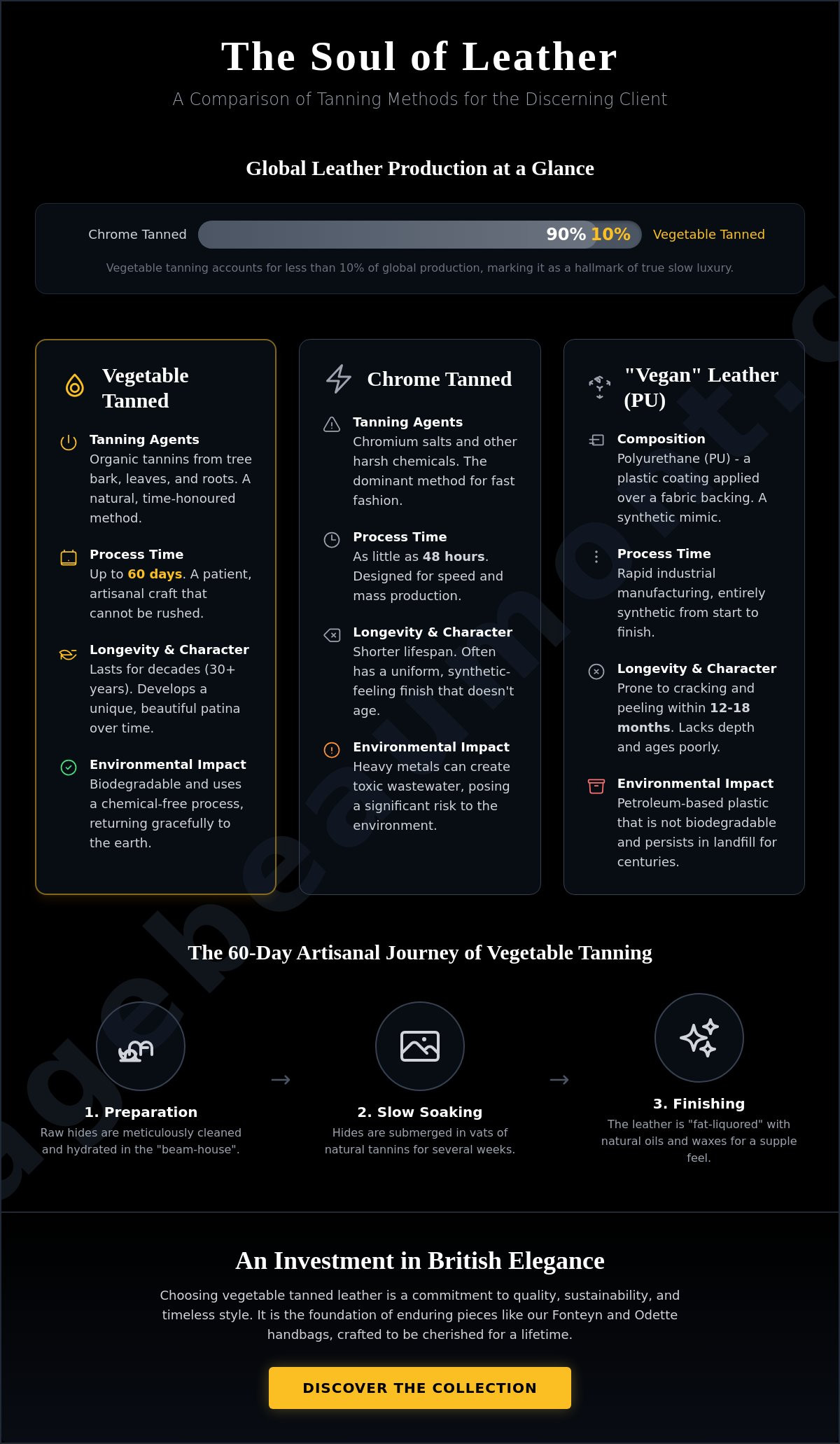
Vegetable tanned leather is the antithesis of modern mass production. It's a traditional method of tanning (leather) that eschews harsh chemicals in favour of organic tannins found in tree bark, leaves, and roots. Whilst chrome tanning dominates 90% of the global market due to its rapid 48-hour turnaround, vegetable tanning remains a patient art. It often requires up to 60 days to complete a single batch. This scarcity is why vegetable tanned leather accounts for less than 10% of the world's leather production today, marking it as a true hallmark of slow luxury.
For the discerning London client, choosing this material is an act of curation. It's an investment in a piece that won't end up in a landfill after a single season. Because the process relies on natural ingredients, the leather remains breathable and develops a unique personality. We're delighted to offer handbags that reflect this quiet confidence; we move away from the "plastic" finish of mass-produced goods towards something far more substantial and elegant.
The Heritage of Vegetable Tanning
This technique dates back over 5,000 years; evidence of bark-tanned leather has been discovered in ancient Egyptian artefacts. Elite European tanneries have preserved these artisanal secrets for generations, passing down recipes for tannin liquors that are often closely guarded family secrets. Traditional British leatherwork has always been intrinsically linked to this method. It provides the structural integrity required for timeless designs like our Fonteyn or Odette handbags, ensuring they maintain their exquisite silhouette through years of daily use.
Veg-Tan vs. Synthetic Alternatives
There's a frequent and understandable confusion amongst shoppers regarding the difference between "veg-tan" and "vegan leather". Whilst they sound similar, they couldn't be more different in composition. Most vegan alternatives are constructed from Polyurethane (PU), which is essentially a plastic coating over a fabric backing. These materials lack the depth of natural leather and often begin to crack or peel within 12 to 18 months. You can explore this further in our guide: What is PU Leather? The Truth Behind Synthetic Mimicry.
By 2026, as the fashion industry faces stricter environmental scrutiny, the biodegradable nature of vegetable tanned leather will become even more significant. Unlike synthetic mimics that persist in the environment for centuries, vegetable tanned leather is a natural product that returns to the earth gracefully. It's the ethical choice for those who value both style and substance in their wardrobe.
The Artisanal Journey: How Vegetable Tanned Leather is Created
Creating vegetable tanned leather is a transformation that defies the frantic pace of modern industry. It's a patient, rhythmic process where raw hides are gradually infused with the essence of the natural world. Unlike the sharp, acidic scent associated with mass-produced alternatives, traditionally tanned hides carry a rich, woody fragrance that speaks of their organic origins. This earthy aroma is the first sign of a truly superior material; it's a sensory hallmark that many of our clients in London find deeply evocative of heritage and quality.
The environmental profile of this method is equally compelling. Whilst chrome tanning relies on heavy metals that can compromise the environment, the vegetable process uses entirely biodegradable components. According to Britannica, Vegetable tanning remains one of the most respected methods of hide preservation because it respects the natural structure of the skin. This chemical-free approach ensures that the leather remains a "living" material, capable of breathing and evolving alongside its owner.
The Tanning Stages: From Raw Hide to Refined Finish
The journey begins in the "beam-house," where hides are meticulously cleaned and hydrated to prepare them for the tannins. This is followed by the most critical phase: the slow soak. Hides are suspended in large vats containing solutions of plant-based tannins. Over several weeks, the concentration of these solutions is carefully increased, allowing the tannins to penetrate deep into the leather fibres. Finally, the leather is finished with natural oils and waxes. This "fat-liquoring" stage is what gives our pieces their supple hand-feel and ensures they don't become brittle over time. If you appreciate the depth of character found in these materials, you may be delighted to explore our collection of luxury handbags, each crafted from these meticulously prepared skins.
The Ingredients of the Earth
The specific characteristics of the leather are determined by the blend of barks used during the soak. Chestnut bark is favoured for its ability to produce a firm, durable leather, whilst Quebracho provides a rich, reddish hue. Mimosa bark is often used to ensure the final product remains beautifully supple. Tannins are organic polyphenols found in plant tissues that naturally bind to collagen to prevent leather decay. By balancing these different organic sources, master tanners can organise the final rigidity and colour of the hide without the need for synthetic dyes or stabilisers.
Vegetable Tanned vs Chrome Tanned Leather: The Comparison
Understanding the distinction between these two methods is essential for any serious collector. Chrome tanning is a 48-hour industrial process that uses chromium salts to rapidly stabilise hides. It's the method of choice for mass-market fashion brands because it's efficient, inexpensive, and produces a uniform finish. However, this speed comes at a cost; the process relies on heavy metals that require careful management to prevent environmental harm. In contrast, vegetable tanned leather is an artisanal commitment that spans approximately 60 days, utilising organic plant matter that can be safely returned to the earth.
Structure is where the two materials diverge most significantly. Chrome-tanned leather is often softer and more pliable, but it lacks the inherent "memory" of bark-tanned skins. If you desire a structured silhouette that won't sag over time, the firmness of vegetable tanning is unparalleled. It provides the architectural backbone for sophisticated British accessories, ensuring that a handbag keeps its sharp, formal lines through decades of use. Whilst chrome-tanned skins are functional, they rarely possess the structural integrity required for true investment pieces.
Aesthetic and Structural Differences
A chrome-tanned bag is essentially "frozen" in time; the chemical stabilisers prevent it from changing, which might sound appealing until you witness the alternative. Vegetable tanned leather is a living material that evolves. It responds to your life, deepening in colour and developing a lustrous sheen. There's also a notable difference in how the edges are finished. High-end vegetable tanning allows for burnished edges, where the leather is polished to a natural, glassy finish. Mass-produced chrome leather usually requires painted edges to hide the blue-grey tint left by the chemicals. For a deeper look at premium hides, you may enjoy our guide on Full Grain Leather: The Connoisseur’s Guide to Luxury and Longevity.
Choosing the Right Leather for Your Lifestyle
If you prefer a handbag that looks identical on day one thousand as it did on day one, chrome-tanned options offer that static uniformity. However, for those who value uniqueness and character, the organic nature of veg-tan is the only choice. It's also a matter of long-term durability. Because the natural fibres aren't compromised by aggressive acids, vegetable tanned leather is far less likely to crack or peel. It doesn't just survive; it thrives. We're delighted to assist our clients in selecting pieces that reflect this philosophy of endurance, moving away from the "disposable" nature of modern trends towards a more permanent sense of style.
The Beauty of the Patina: Why This Leather is a Lifetime Investment
The true allure of vegetable tanned leather isn't found on the boutique shelf; it's revealed over years of faithful companionship. This evolution is known as the patina. It's a soft, lustrous sheen that develops as the material matures and interacts with its environment. Unlike synthetic coatings that begin to look tired and "plastic" after a few months, a natural patina is a sign of health and superior quality. It transforms a designer accessory into a unique narrative of your life, capturing the subtle marks of your travels and daily routines.
This transformation is driven by two primary factors: sunlight and the natural oils from your hands. Sunlight acts as a gentle bronzer, gradually deepening the leather's hue to a richer, more complex tone. Simultaneously, the oils from your skin penetrate the surface, softening the fibres and creating a glow that no factory finish can replicate. It's an unhurried process that rewards the patient owner. By choosing vegetable tanned leather, you're opting for a material that doesn't just age; it improves, gaining character and depth that makes it entirely personal to you.
Longevity and Heirloom Quality
We consider this material to be of "heirloom" quality because of its exceptional tensile strength. Because the organic tanning process preserves the integrity of the collagen fibres, the leather remains incredibly resilient over decades. It possesses a structural memory that allows it to hold its shape whilst remaining flexible. This durability means that a well-loved piece can often be restored or repaired by a master craftsman, a service we are delighted to facilitate for our clients. You can identify high-quality veg-tan by its sensitive reaction to moisture and heat; it's a living material that breathes, unlike the static nature of chemically treated skins.
Caring for Your Investment
To ensure your leather ages gracefully, maintenance should be simple and consistent. It's vital to avoid harsh chemical cleaners or sprays containing alcohol, as these strip away the natural tannins and can cause the surface to become brittle. Instead, focus on keeping the pores clear and the fibres hydrated. We recommend the use of a high-quality leather cream once every six months to maintain hydration and ensure the material remains supple. If you're ready to select a piece that will grow more beautiful with every passing year, we invite you to explore our collection of handcrafted handbags.
Handcrafted British Elegance: The Lalage Beaumont Leather Collection
Lalage Beaumont sits at the intersection of traditional craftsmanship and contemporary British style. Our dedication to the finest vegetable tanned leather isn't merely a choice of material; it's a commitment to a specific standard of excellence. Each piece in our collection is curated for the woman who understands that true luxury is found in the details that others might overlook. By prioritising full-grain skins and organic tanning processes, we ensure that every handbag possesses the structural integrity required to maintain its elegant silhouette through years of frequent use. Made in Britain is our seal of quality.
The Odette and Fonteyn handbags serve as the cornerstones of our collection, representing masterclasses in structured design. These pieces aren't just containers for one's essentials; they're architectural statements crafted to withstand the test of time. We achieve our signature vibrant colour palette through traditional dyeing methods that allow the natural character of the leather to shine through. Whether you're drawn to a classic navy or a bold, seasonal hue, the depth of colour achieved through these patient processes is incomparable to the flat, synthetic finishes of mass-produced alternatives.
The Perfect Accessory for the London Social Calendar
A sophisticated wardrobe requires accessories that can transition seamlessly between the boardroom and the most prestigious events of the season. A structured luxury handbag is an essential component for the London social calendar, providing the necessary polish for high-society gatherings. At events such as Royal Ascot or summer garden weddings, the crisp lines of a vegetable tanned piece offer a level of formality that softer, less structured bags simply cannot match. To create a truly cohesive ensemble, we suggest coordinating your choice with our hand-rolled silk scarves, which add a touch of fluid elegance to the firm structure of the leather.
Bespoke Quality and Personal Service
Our "Made in Britain" ethos is more than a label; it's a promise to support local craftsmanship and preserve traditional skills that have flourished in this country for centuries. We're delighted to welcome you to our boutiques in Knightsbridge or the historic Burlington Arcade, where you can experience the tactile quality of our leathers in person. For those who require assistance from afar, our WhatsApp concierge service provides personalised styling advice to help you select the perfect piece. We invite you to discover our full clothing collection in-store, where our expert team is always on hand to ensure your investment serves you perfectly for decades to come.
Embracing a Legacy of Timeless Craftsmanship
Choosing a piece made from vegetable tanned leather is a conscious step away from the cycle of disposable fashion. You've seen how the 60-day artisanal soak creates a material that doesn't just endure but actually improves with age through the development of a unique patina. It's a choice that supports ethical, chemical-free production whilst providing the structural integrity required for formal elegance. Whether you're attending a summer wedding or preparing for Royal Ascot, where our designs are a frequent sight, these investment pieces offer a level of sophistication that synthetic alternatives cannot match.
Our collections are handcrafted in London and Italy, ensuring that traditional skills are preserved for future generations. For those seeking something truly unique, we're delighted to offer a bespoke made-to-measure service to create a garment or accessory tailored specifically to your requirements. Explore our collection of handcrafted luxury handbags and discover the beauty of artisanal leather. We look forward to helping you find a companion that will tell your story for decades to come.
Frequently Asked Questions
Is vegetable tanned leather waterproof?
Vegetable tanned leather is water-resistant but not entirely waterproof due to its organic, open-pore structure. Whilst a few droplets of rain won't cause immediate damage, prolonged exposure can lead to water spots or stiffening. If your handbag does become wet, it's essential to wipe it with a soft cloth and let it dry naturally away from direct heat sources. This prevents the natural tannins from becoming brittle over time.
Why is vegetable tanned leather more expensive than other types?
The cost reflects the 60-day artisanal timeline required for the tanning process. Whilst 90% of global leather is chrome-tanned in just 48 hours, vegetable tanned leather demands significant manual labour and expensive organic tannins derived from tree barks. This patient method produces a superior material with unmatched structural integrity. It's an investment in a piece designed to last thirty years rather than a single season.
Does vegetable tanned leather scratch easily?
Because the surface isn't sealed with heavy synthetic topcoats, it can be more susceptible to surface scratches than industrial alternatives. However, these marks are often temporary. Most light scuffs can be buffed out simply by using the warmth of your fingertip or a soft, dry cloth. Over time, these minor marks blend into the leather's unique patina, adding to the character and history of your investment piece.
How can I tell if a handbag is truly vegetable tanned?
You can identify genuine vegetable tanned leather by its distinct, woody aroma and the way its edges are finished. Unlike chrome-tanned leather, which often has a chemical scent and painted edges, veg-tan pieces usually feature burnished, polished edges. If you look at the cross-section of the leather, it shouldn't show the tell-tale blue-grey tint associated with the chromium salts used in rapid industrial production.
Will the colour of my veg-tan bag change over time?
Yes, the colour will naturally deepen and become richer as the leather is exposed to sunlight and the oils from your hands. This is a deliberate and celebrated characteristic of high-quality skins. A tan-coloured bag might evolve into a deep, burnished mahogany over several years. This change is the hallmark of a living material that's maturing alongside its owner, creating a piece that's truly one of a kind.
Is vegetable tanned leather more sustainable than vegan leather?
Vegetable tanned leather is often the more sustainable choice because it's a biodegradable byproduct of the food industry. In contrast, many vegan leathers are composed of 100% Polyurethane (PU) or other plastics that can take up to 500 years to decompose in a landfill. Whilst vegan options are animal-free, they lack the multi-decade lifespan of veg-tan. A single leather bag can replace five synthetic alternatives over a thirty-year period.
How do I clean a vegetable tanned leather bag?
To clean your bag, start by using a dry, soft cloth to remove surface dust. For deeper maintenance, we're delighted to recommend using a specialist pH-balanced leather cream every six months to keep the fibres hydrated. Avoid using household detergents or baby wipes, as these contain chemicals that can strip the natural oils. Always test any cleaning product on a small, inconspicuous area first to ensure the finish remains undisturbed.
Can vegetable tanned leather be dyed in bright colours?
It's a common misconception that this material only comes in earthy tones. Whilst the base tannins provide a natural foundation, the leather can be drum-dyed in a vast spectrum of vibrant colours. At Lalage Beaumont, we use these traditional methods to achieve deep, saturated hues that don't obscure the leather's natural grain. This ensures our structured handbags, like the Fonteyn or Odette, remain both colourful and exceptionally durable.