


That "Genuine Leather" stamp you see on high-street accessories isn't a mark of prestige; it's actually a polite industry term for one of the lowest grades of material available. It's frustrating to discover that a label meant to reassure you often masks a lack of durability and heritage. We understand that you seek an investment piece, perhaps a Maya or Fonteyn handbag, that will age with grace over the coming decades. With the global leather goods market projected to reach USD 566.23 billion in 2026, the sheer volume of marketing jargon can feel overwhelming. We're delighted to help you distinguish between the various types of leather so you can shop with absolute confidence.
By learning to identify high-quality grain and the nuances of the tanning process, you'll avoid the disappointment of materials that fail to stand the test of time whilst ensuring your collection remains timeless. We'll examine the differences between full-grain and corrected hides. We'll also detail how the new OEKO-TEX® 2026 standards, which take full effect on 1 June 2026, ensure your luxury pieces meet the most stringent environmental benchmarks. This guide provides a clear path through the technicalities, from understanding CITES certificates for exotic skins to appreciating the quiet confidence of British craftsmanship.
Key Takeaways
- Understand the biological structure of a hide to identify why the grain is the most vital component for long-term durability.
- Compare the traditional artistry of vegetable tanning with modern methods to choose a finish that aligns with your aesthetic and environmental values.
- Explore the benefits of specialised bovine varieties that provide the sophisticated look of exotic skins with enhanced structural integrity.
- Master the ability to choose between different types of leather to ensure your accessories perfectly complement your tailored coats and silk ensembles.
- Learn to spot the subtle signs of corrected hides so you can invest in materials that develop a beautiful, natural patina over time.
Defining Quality: The Anatomy and Origin of Premium Leather
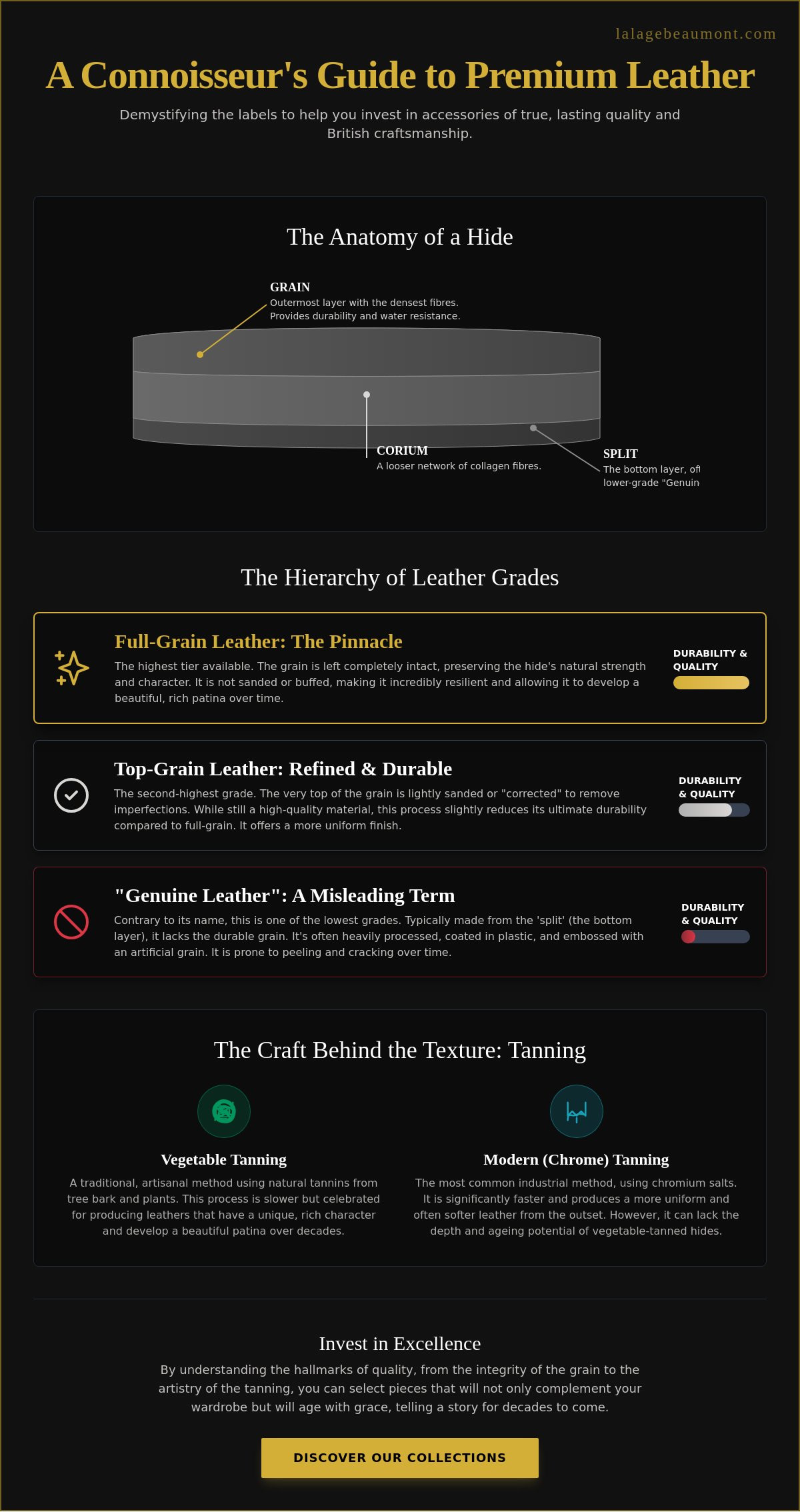
Leather is far more than a simple material; it's a living, breathable medium that possesses a unique character synthetic alternatives can't hope to replicate. To truly appreciate the finest types of leather, one must understand the biological architecture of the hide itself. The structure is primarily divided into two layers: the grain and the corium. The grain is the outermost surface, containing the densest fibres that provide legendary durability and water resistance. Beneath this lies the corium, a looser network of collagen fibres. For a structured handbag like the Maya or the Fonteyn, we only select hides where the grain remains entirely intact. This ensures the piece maintains its elegant silhouette and structural integrity for decades.
A deeper look at Leather production and types reveals that bovine leather remains the undisputed gold standard for luxury accessories. Its inherent strength and generous surface area allow craftsmen to cut large, seamless panels. This is essential for creating the clean, architectural lines found in our handbag collections. High-end production is incredibly selective; only about 10% of global hides are considered "unblemished" enough to be used in their natural state without heavy chemical correction.
The Importance of Provenance
Superior leather begins with the environment. We favour European hides, particularly those from heritage farms in Britain and Northern Europe. The cooler climates and controlled diets in these regions result in thicker, healthier hides with fewer insect bites or markings. Traditional tanneries in Britain and Italy have spent centuries perfecting the art of preserving this natural quality. They treat each hide with a level of care that mass-production facilities don't offer, ensuring the leather remains supple yet resilient.
Natural Markings: The Signature of Authenticity
True luxury doesn't mean perfection in a clinical sense. Slight variations in the grain or subtle growth marks are hallmarks of a genuine, natural product. Whilst mass-market brands often use heavy plastic coatings or aggressive sanding to hide imperfections, we celebrate the "naked" finish. This allows the leather to breathe and develop a rich, personal patina over time. It's a sign of a piece that hasn't been over-processed. When you invest in a quality leather accessory, you're choosing a material that grows more beautiful with every use, reflecting a life well-lived.
The Hierarchy of Hides: Understanding Full-Grain and Top-Grain
Marketing terminology often obscures the reality of material quality. You might see "Genuine Leather" stamped on a belt or wallet and assume it signifies excellence. In truth, this label typically denotes a low-grade split leather that lacks the structural integrity of the upper layers. It's essentially the "particle board" of the leather world; often a mix of scraps bonded with polyurethane. For those seeking true longevity, understanding the hierarchy of types of leather is the first step toward a wise investment.
Genuine leather is frequently just the bottom layer of the skin, known as the split. It lacks the grain entirely. Manufacturers often coat it in a thick layer of pigment or plastic to mimic the look of better hides. It might look acceptable on the shelf, but it will peel and crack within a few years. It's a poor choice for an investment piece meant to last a lifetime.
Full-Grain: The Pinnacle of Luxury
Full-grain leather is the highest tier of hide that has not been sanded or buffed. Because the surface remains untouched, the natural fibre density is preserved, making it incredibly resilient. This is why a piece like the Odette Handbag retains its shape so beautifully over time. Rather than wearing out, full-grain develops a soft, lustrous patina. It tells a story of use without compromising its form. The leather tanning and finishing process for these hides is meticulous, as there is no heavy coating to hide any underlying weaknesses.
Top-Grain and Corrected Leathers
Top-grain leather occupies the second tier. Here, the very top layer of the grain is sanded or buffed to remove natural scars or insect bites. Whilst this creates a "perfect" and uniform appearance, it removes the strongest fibres. It's often used when a designer requires a specific, flat colour or a highly consistent finish across a large production run. You'll recognise corrected grain by its overly uniform, almost plastic-like texture. It doesn't breathe as well as full-grain, and it won't develop that coveted patina. If you appreciate the unique character of a natural material, full-grain is always the superior choice.
Choosing the right material ensures your accessory remains a staple in your wardrobe for a lifetime. If you would like to experience the tactile difference of these premium materials, we would be delighted to welcome you to our London boutiques to view our latest collections.
Tanning and Finishes: The Craft Behind the Texture
Tanning is the transformative stage where a raw hide becomes a sophisticated, durable material. To appreciate the various types of leather, one must look at the artistry behind the tanning process. Vegetable tanning is the traditional choice, utilizing natural tannins found in tree bark and plant extracts. This method is unhurried; it can take several months to complete. The result is a material with a distinctive, earthy scent and a firm handle that softens beautifully over time. Whilst chrome tanning is a more modern innovation developed in the late 19th century, it now accounts for a significant portion of global production due to its speed and efficiency. The U.S. leather industry and European tanneries often employ these methods to create leathers that are supple, heat-resistant, and capable of holding vibrant dyes.
The way a hide is dyed dictates its final character and sensory appeal. Aniline dyes are entirely transparent, soaking deep into the fibres without masking the natural grain. This honest finish is reserved for only the most exceptional hides. Semi-aniline dyes introduce a light layer of pigment, offering a balance between natural beauty and resilience against spills or sunlight. These types of leather are ideal for investment pieces that require a refined appearance whilst standing up to the demands of a busy social calendar.
The Velvet Touch: Suede and Nubuck
Suede is crafted from the underside of the hide, offering a soft, napped finish that is synonymous with understated luxury. It provides a tactile depth that is perfect for seasonal accessories and softer silhouettes. For those who wish to maintain the pristine appearance of these delicate pieces, our guide on What is Suede? provides expert care instructions. Nubuck, whilst similar in feel, is top-grain leather that has been lightly buffed on the outside. This makes it more durable than suede whilst retaining that coveted, velvet-like texture.
Patent and Pigmented Finishes
Patent leather has long been a favourite for formal evening wear and high-society events like Royal Ascot. Its high-gloss surface is achieved through multiple layers of lacquer, creating a mirror-like shine that doesn't fade. Whilst striking, it requires careful storage to prevent colour transfer or cracking. Pigmented finishes use a heavier coating of colour to protect the hide. This allows for the vibrant, consistent hues required for modern occasion wear and ensures your handbag remains protected from the unpredictable British weather. These finishes provide a uniform look that complements the structured lines of a tailored coat or a silk shift dress.
Exotic Finishes and Specialised Bovine Varieties
Texture adds a layer of sophistication that flat leather sometimes lacks. Whilst genuine exotic skins like crocodile or lizard have a storied history in luxury, specialised bovine varieties often provide a more resilient and ethical alternative. These types of leather are created using high-definition luxury stamping, which applies heat and pressure to premium calfskin to replicate the intricate scales of a reptile. Unlike cheap embossing found in mass-market goods, which often looks repetitive and shallow, luxury stamping captures the varying depths and organic irregularities of a natural hide. This ensures the material behaves like a genuine exotic skin, catching the light in a way that feels organic rather than manufactured.
This tactile depth is particularly effective when coordinating an ensemble for high-profile events. A crocodile-print handbag provides a necessary visual anchor for tonal luxury mother of the bride outfits, where the interplay of light and shadow on the leather breaks up a monochromatic silk or wool look. Given that the international exotic leather market was valued at approximately $830 million in 2025, the demand for this aesthetic remains high, yet the durability of bovine leather makes it a far more practical choice for a piece intended for frequent use. It doesn't require the same level of delicate handling as true reptile skins, which can be prone to drying or lifting scales if not professionally maintained.
Calfskin: The Designer’s Favourite
Calfskin is the preferred medium for our most structured silhouettes, such as the Coppelia or the Manon. It offers a remarkably fine grain and a lightweight nature that belies its strength. Calfskin is significantly softer than adult cowhide due to the smaller pore structure. This density allows the leather to hold its shape over decades without becoming stiff or brittle. It's the ideal choice for an investment piece that must look as sharp at a gallery opening as it does at a formal wedding. This material represents the perfect marriage of elegance and endurance.
Avoiding the Synthetic Trap
In a market increasingly flooded with "vegan" alternatives, it's vital to understand What is PU Leather? and the reality of synthetic mimicry. Most vegan leathers are essentially plastic, which lacks the breathability and longevity of the real material. These synthetic options often begin to peel or degrade within two years, contributing to environmental waste. Real leather remains the sustainable choice for the conscious consumer who values slow fashion. It's a natural by-product that, when sourced responsibly, offers an endurance that plastic simply cannot match.
If you are looking for a piece that combines the allure of exotic textures with the resilience of premium calfskin, we invite you to explore our handbag collection today.
Investing in Excellence: Selecting the Perfect Leather for Your Wardrobe
Selecting an investment piece is an intimate process that requires a thoughtful understanding of how different types of leather respond to the demands of your lifestyle. For daily professional use, a robust calfskin provides the necessary resilience to withstand the rigours of city life whilst maintaining its polished appearance. Conversely, for the height of the social season, the choice becomes more nuanced. Structured, smooth leathers are the ideal companion for occasion hats and delicate silk ensembles, as they offer a clean, architectural contrast to the softness of the fabric. The projected growth of the global leather goods market to USD 566.23 billion by late 2026 suggests a marketplace saturated with options, making the ability to discern quality more vital than ever.
Consider your social calendar as your primary guide. A winter wedding might call for the rich, deep tones of a pigmented finish that resists the damp, whilst the bright lawns of Royal Ascot demand the mirror-like perfection of a patent or high-definition stamped calfskin. We meticulously select specific Italian leathers for our collections, ensuring that every piece remains a timeless investment that transcends seasonal trends. These materials are chosen not just for their immediate beauty, but for their ability to complement the formal silhouettes of our tailored coats and silk shift dresses.
The Longevity Factor
When inspecting a potential addition to your wardrobe, look beyond the initial aesthetic. Quality is found in the details; check that the edges are cleanly finished and the stitching is uniform and tight. A "pull-up" test, where the leather is lightly folded to see if the oils shift and change colour, is a classic marker of a rich, full-grain hide. Investing in a single, high-quality piece is a far more sustainable approach than frequent replacements of inferior materials. Over time, a full-grain accessory develops an emotional value that mass-produced items cannot replicate. It ages gracefully alongside its owner, recording a history of elegant occasions and significant life events.
A Final Note on Care
Preserving the lustre of your leather goods is a simple yet rewarding task. Regular dusting with a soft, dry cloth and the occasional use of a specialist cream will keep the fibres supple. For heirloom pieces, professional cleaning is a worthwhile investment that ensures the leather remains in pristine condition for the next generation. If you would like some assistance in selecting a piece that perfectly suits your requirements, we would be delighted to assist you in finding your next investment at our London boutiques.
Embrace a Lifetime of Timeless Elegance
Armed with a connoisseur’s understanding of the various types of leather, you're now perfectly positioned to make an informed investment. You know that the strength of full-grain hides and the precision of specialist tanning are what define a piece that lasts decades rather than seasons. Selecting the right accessory involves more than just aesthetics; it's about choosing a material that reflects your lifestyle and the significance of your social calendar. Whether you require a structured calfskin for a professional engagement or a high-definition print for a formal occasion, the quality of the hide remains paramount.
Our collections are meticulously handcrafted in Italy and Spain to meet these exacting standards. We're also delighted to offer bespoke made-to-measure services for those seeking a truly unique addition to their wardrobe. We invite you to visit our boutiques in Knightsbridge and the Burlington Arcade to experience these luxurious textures in person. Explore our collection of handcrafted leather handbags and discover a piece that will age as gracefully as the memories you create with it.
Frequently Asked Questions
Is full-grain leather better than top-grain leather?
Full-grain is superior for those seeking a piece that ages with grace. It retains the dense, outermost fibres of the hide, whilst top-grain is sanded to remove surface markings. This sanding process weakens the material and prevents the development of a natural patina. If you value a handbag that tells a story over decades, full-grain is the definitive choice for your collection.
What is the most durable type of leather for a handbag?
Full-grain bovine leather is the most durable option for a structured handbag. Its high fibre density ensures that silhouettes like the Maya or the Fonteyn maintain their architectural lines for years. Calfskin is also exceptionally hardy due to its tight pore structure. These types of leather offer a level of resilience that lower grades simply cannot match, especially when subjected to daily use.
Can you tell the difference between real leather and PU leather?
You can distinguish genuine hides from PU by their scent and tactile response. Real leather possesses a rich, earthy aroma and a surface that feels warm to the touch. PU leather is a synthetic plastic that often smells of chemicals and feels unnaturally smooth or tacky. Whilst PU might look convincing initially, it typically begins to peel or crack within 18 to 24 months of use.
Does expensive leather scratch easily?
The susceptibility to scratching depends entirely on the finish rather than the price. Aniline leathers are more delicate because they lack a protective pigment layer. However, our high-definition stamped calfskin is remarkably resilient. These textured surfaces disguise minor abrasions, making them an excellent choice for a busy social calendar. Proper care ensures even the finest materials remain in pristine condition.
What happens if my luxury leather bag gets wet?
If your accessory is caught in a British downpour, wipe it immediately with a soft, dry cloth. You should then allow it to dry naturally at room temperature. Never use a hairdryer or place it near a radiator; excessive heat causes the leather to stiffen and crack. For heirloom pieces, we would be delighted to offer professional advice on restoration should any water spotting occur.
Is vegetable-tanned leather better for the environment?
Vegetable tanning is widely considered the more sustainable choice amongst the various types of leather production. It utilises organic tannins derived from tree bark and plant extracts rather than the heavy metals used in chrome tanning. Although the process takes significantly longer to complete, usually several months, it results in a biodegradable material that is much kinder to the environment.
Why does some leather smell different than others?
The scent is a direct result of the tanning and finishing agents used during production. Vegetable-tanned leather has a sweet, woody aroma that many connoisseurs find highly desirable. Chrome-tanned pieces may have a more neutral or slightly metallic scent. If a product smells strongly of plastic or glue, it's often a sign of a low-grade split leather that's been heavily treated with synthetic coatings.
How often should I condition my leather accessories?
We recommend conditioning your leather goods once or twice a year to maintain their suppleness. Over-conditioning can actually harm the structure, causing the leather to become too soft and lose its shape. A light application of a specialist cream every 6 to 12 months is sufficient to replenish the natural oils. This simple routine ensures your investment piece remains a staple of your wardrobe for a lifetime.