

The logo on a designer purse handbag tells you almost nothing about its quality. What truly matters is what you cannot see at first glance: the tension of each hand-stitch, the grain of the leather, the quiet precision of a seam that will hold its shape for decades. Yet so many women find themselves paying a premium for a name rather than for the craftsmanship beneath it, and that is a distinction worth understanding before you invest.
You're not alone if you've stood in a boutique feeling quietly overwhelmed, unsure whether the bag in your hands is genuinely worth its price or simply dressed in a recognisable silhouette. The confusion over leather grades, construction techniques, and which styles will actually serve you across occasions, from a business meeting to a wedding, is entirely understandable.
This guide is here to change that. We'll walk you through exactly what separates a truly handcrafted piece from a mass-market imitation, how to read the details that signal lasting quality, and how to choose a bag with the confidence that it will become one of the most versatile and enduring pieces in your wardrobe.
Key Takeaways
- The 'designer' label is not a guarantee of quality — understanding what truly defines a designer purse handbag means looking beyond the name to the materials, construction, and artisanal heritage behind it.
- Full-grain leather and hand-stitching are the hallmarks of a bag built to last; knowing how to identify these details will transform the way you shop.
- The right silhouette can carry you seamlessly from a boardroom to a wedding reception — discover which shapes offer the greatest versatility across your wardrobe.
- Spending more on a single, well-crafted piece is often the more economical and environmentally responsible choice in the long run, thanks to the cost-per-wear principle.
- Handcrafted collections rooted in timeless British elegance — such as the Fonteyn and Odette — offer a compelling alternative to trend-led luxury, prioritising enduring style over fleeting fashion.
What Defines a Designer Handbag in 2026?
The word 'designer' has been stretched so thin in recent years that it risks meaning very little at all. Slapped across everything from airport gift shop accessories to fast-fashion collaborations, the label has become more marketing shorthand than meaningful distinction. What it ought to signify is something altogether more considered: a commitment to a specific aesthetic vision, a defined quality standard, and a consistency of craft that holds from one piece to the next.
A genuine designer purse handbag is not simply a bag with a recognisable name attached to it. It's the physical expression of a designer's personal vision, one that prioritises enduring silhouette over seasonal trend. That distinction matters enormously when you're deciding where to place your investment.
You'll also notice that 'purse' and 'handbag' tend to be used interchangeably across global markets. In American English, 'purse' describes what British speakers call a handbag; in British English, a purse is typically a small coin wallet. Neither usage is incorrect. Throughout this guide, we use both terms to reflect the international conversation around these pieces, without losing sight of the distinctly British craftsmanship tradition that shapes the finest examples.
Artisanship vs. Mass Production
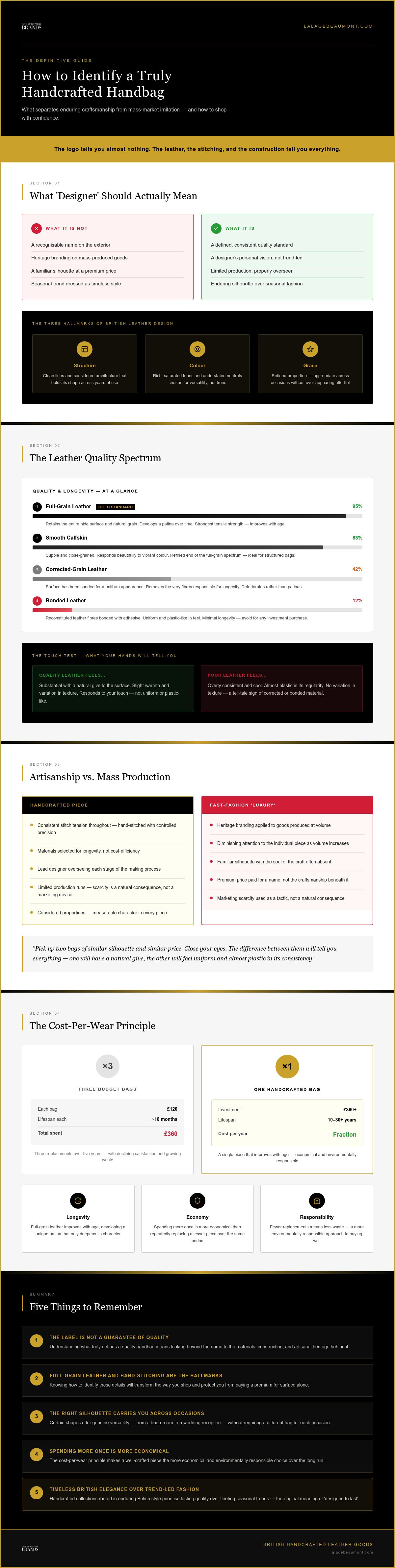
Luxury artisanship sits at the intersection of heritage techniques and modern utility, and that definition separates a handcrafted piece from one that simply carries a premium price tag. When production is limited and a lead designer is genuinely overseeing each stage of the making process, the result is a bag with measurable character: consistent stitch tension, considered proportions, and materials selected for their longevity rather than their cost-efficiency. Limited production runs also protect the integrity of a design; scarcity here isn't a marketing device, it's a natural consequence of making things properly.
Contrast this with the 'fast fashion luxury' model, where heritage branding is applied to goods produced at volume with diminishing attention to the individual piece. The silhouette may be familiar, but the soul of the craft is often absent.
The Evolution of the British Handbag
London has long been a centre of leather goods excellence, its arcades and boutiques home to makers who treat structure and colour as a form of quiet eloquence. In 2026, the prevailing mood within British design is one of quiet luxury: restrained, confident, and deeply intentional. The hallmarks of British style in leather goods tend to be:
- Structure: clean lines and considered architecture that holds its shape across years of use
- Colour: a palette that moves between rich, saturated tones and understated neutrals, chosen for versatility rather than trend
- Grace: a refinement of proportion that makes a bag feel appropriate across occasions without ever appearing effortful
Boutiques such as those found in Knightsbridge and Burlington Arcade exemplify this tradition, offering handcrafted leather handbags that carry the quiet authority of pieces made with genuine intention. That is what 'designer' should mean, and increasingly, discerning women are returning to that original standard.
The Anatomy of Luxury: Materials and Hand-Stitching
Pick up two bags of similar silhouette and similar price. Close your eyes. The difference between them will tell you everything. One will feel substantial, with a slight give to the surface that speaks of natural fibre; the other will feel uniform, almost plastic in its consistency. That tactile distinction is where the real education in leather goods begins.
Leather Grades: Full Grain to Calfskin
Full-grain leather is the gold standard for any investment-grade designer purse handbag, and the reason is structural. It retains the entire surface of the hide, including the natural grain, which means it carries the hide's inherent tensile strength intact. Over time, it develops a patina rather than deteriorating, ageing in a way that actually improves its character. Corrected-grain and bonded leathers, by contrast, have been sanded or reconstituted to achieve a uniform appearance, and that process removes precisely the fibres that give leather its longevity.
Smooth calfskin sits at the refined end of the full-grain spectrum. It's supple, close-grained, and responds beautifully to vibrant colour, which is why it's so frequently chosen for structured bags where both elegance and durability are non-negotiable. Textured finishes, such as pebbled or grained leathers, offer a degree of practical resilience, disguising minor scuffs more readily than a polished surface. Neither is superior in absolute terms; the choice depends on how and where you intend to carry the bag. For a deeper understanding of how these grades are produced and what distinguishes them at source, this connoisseur's guide to leather types and longevity is a genuinely useful reference.
The Significance of Hand-Stitching
A single hand-stitched bag can take days to complete, and that time is not inefficiency; it's the deliberate reinforcement of every tension point along the seam. The saddle stitch, the traditional technique used by skilled leather artisans, uses two needles working simultaneously through pre-punched holes. If one thread breaks, the other holds. Machine stitching, by contrast, uses an interlocking loop system: one broken thread can cause an entire seam to unravel from that point outward.
The aesthetic result of hand-stitching is equally compelling. The slight variation in each stitch, barely perceptible to the eye, gives a seam its handcrafted signature, a quality that no automated process can replicate with the same integrity.
Beyond the leather and the stitching, the interior architecture of a well-made bag matters considerably. Quality linings in suede or structured fabric protect the contents and prevent the outer leather from losing its shape. Hidden reinforcements at the base and handle attachments are what prevent the bag from sagging after sustained use. And hardware deserves equal scrutiny: solid brass fittings with a lacquer or plating that resists tarnishing will outlast lightweight alloy alternatives by years.
These are the details that separate a bag built to be carried from one built to be admired briefly and then replaced. If you'd like to see how these principles translate into practice, the handcrafted leather handbag collection offers a considered starting point.
Selecting the Perfect Silhouette for Your Wardrobe
A bag's shape does more work than most women realise. It shifts the visual weight of an entire outfit, communicates intention before you've said a word, and either complements or competes with the silhouette you're wearing. Getting that relationship right is less about following rules and more about understanding a few principles that will serve you across every occasion in your wardrobe.
Size is the first consideration. A medium-sized structured bag sits in a particularly useful sweet spot: substantial enough to carry the essentials for a full working day, refined enough to accompany you directly into an evening engagement without the need to change. That day-to-evening transition is where so many women lose confidence, reaching for a second bag when one well-chosen piece would have carried them through seamlessly.
Structured vs. Soft Silhouettes
A structured bag brings an immediate sense of authority to an outfit. Worn to a board meeting, a client lunch, or a formal appointment, it signals that the wearer has considered her appearance with care. The clean geometry of a structured silhouette also flatters by contrast: paired with a fluid silk dress or wide-leg trousers, it provides the visual anchor that prevents an outfit from reading as unfinished. The Fonteyn, with its considered proportions and hand-stitched construction, is precisely the kind of piece that performs this role with quiet reliability.
Softer, more malleable leather designs offer a different kind of elegance. They carry a relaxed ease that reads beautifully in social settings where rigidity would feel out of place, and they tend to complement textured fabrics such as tweed particularly well. The choice between the two is ultimately a question of occasion and personal dressing style, not hierarchy.
Colour deserves equal thought. A classic black or tan carries you across the broadest range of occasions without demanding coordination. But a bag in a rich jewel tone, deep emerald, cobalt, or a warm burgundy, can become the defining element of an otherwise neutral outfit. Seasonal shades reward confidence; they're the detail that elevates a well-cut coat into something genuinely memorable.
Styling for the British Social Calendar
The British social season presents a specific set of dressing challenges that generic style advice rarely addresses. Royal Ascot, Henley, summer weddings, and autumn country gatherings each carry their own dress codes, and your choice of designer purse handbag should be as considered as the outfit itself.
For occasions such as a London wedding or a formal race day, a structured bag in a complementary tone to your outfit is almost always the correct instinct. If you're dressing as a mother of the bride, the bag should support the overall look rather than compete with it; a considered guide to luxury mother of the bride outfits can help you understand how the complete ensemble should sit together.
When occasion hats are part of the picture, the general principle is to let one element lead. If your hat is the statement piece, your bag should be elegant and restrained. If the bag carries the colour, the hat can afford to be more architectural. The two should converse, not compete. A silk scarf tied to the handle of a structured bag is one of the most effortless ways to bridge the two, drawing the palette together without over-coordinating.
Body proportion is worth a brief note. A bag that sits at hip height will draw the eye to that point; a shorter top-handle style worn at the crook of the arm creates a longer, leaner visual line. Neither is universally superior, but understanding the effect allows you to make the choice deliberately rather than by chance.
Investing in Longevity: The Cost Per Wear Philosophy
There's a more honest way to think about the price of a well-made bag. Rather than measuring it against what you spent, measure it against how many times you carry it. A designer purse handbag that accompanies you three times a week across five years has been carried roughly 780 times. Divided over that number, even a considered investment becomes remarkably reasonable. The bag you bought for a fraction of the price but replaced twice in the same period has cost you more, in money, in time, and in the quiet frustration of watching something deteriorate before it should.
Classic colours are central to this calculation. Navy, black, cream, and deep tan don't ask permission from each season's colour story. They simply work, year after year, across every corner of your wardrobe. A bag in one of these tones will carry you from a January board meeting to a June wedding without ever feeling out of step. That consistency is not dullness; it's the quiet intelligence of a purchase made with genuine foresight.
Caring for leather properly extends its life considerably. A few habits make a meaningful difference:
- Condition regularly: a good leather conditioner, applied every few months, prevents the surface from drying and cracking
- Store with care: keep the bag stuffed with tissue paper when not in use to preserve its structure, and store it in its dust bag away from direct light
- Address moisture promptly: if the leather gets wet, blot it gently and allow it to dry naturally, away from heat sources
- Rotate your bags: resting leather between uses allows it to recover its shape and breathe
Sustainability Through Quality
The environmental argument for buying well is straightforward. Every bag produced requires resources; every bag discarded adds to waste. Choosing one handcrafted piece over several disposable alternatives reduces that impact considerably. When a bag is made by skilled artisans using traditional techniques, it's also built to be repaired rather than replaced. A re-stitched handle or a reconditioned surface extends the life cycle significantly, and that capacity for repair is itself a mark of quality construction. The finest pieces carry heirloom potential; a bag made with genuine integrity is entirely capable of passing between generations.
Versatility Across the Seasons
A well-chosen leather handbag earns its place across every season. In autumn, it sits beautifully alongside designer tweed jackets, the structured leather providing a considered counterpoint to the texture of the cloth. Come summer, the same bag transitions effortlessly with a silk dress, its clean lines complementing the fluid fabric without competing. In winter, carried against a tailored wool coat, it anchors the whole look with quiet authority.
One of the most elegant and practical ways to refresh a bag across seasons is through silk scarves. Tied to a handle or looped through a clasp, a scarf introduces colour, pattern, or seasonal warmth without requiring a new purchase. It's the kind of detail that transforms a familiar piece into something that feels considered and current, without costing the bag its essential character.
If you're ready to invest in a piece built for exactly this kind of longevity, explore the handcrafted leather handbag collection and discover which silhouette will serve you best across the years ahead.
Discovering Handcrafted Elegance at Lalage Beaumont
There are very few places where the principles explored throughout this guide come together quite so completely. Lalage Beaumont's philosophy is built on a single, quietly radical idea: that a truly well-made designer purse handbag needn't follow the season's agenda. It should simply be beautiful, properly made, and capable of accompanying its owner through years of life without apology or replacement.
That conviction shapes everything, from the selection of full-grain leathers to the artisans entrusted with the hand-stitching. The Fonteyn and Odette, two of the collection's most enduring silhouettes, embody this approach with particular clarity. The Fonteyn's structured architecture and considered proportions make it equally at home in a boardroom and at a formal occasion; the Odette offers a refined softness that suits social settings with equal ease. Both are handcrafted in Europe by skilled artisans using traditional techniques, and both carry the vibrant, carefully curated colour palette that has become a signature of the collection.
The London Boutique Experience
Choosing a leather bag online is entirely possible, but it doesn't replicate the experience of holding one. Visiting the Knightsbridge showroom or the Burlington Arcade boutique allows you to feel the weight of the leather, observe the stitch tension at close range, and understand how a particular silhouette sits against the body. The team there brings genuine expertise to the conversation, offering personal styling guidance that takes your wardrobe, your occasion, and your individual proportions into account. It's the kind of unhurried, attentive service that transforms a purchase into a considered decision. You're welcome to view the full range of handcrafted leather handbags online before you visit, or simply arrive and let the collection speak for itself.
A Commitment to Excellence
Lalage Beaumont's dedication to traditional craft isn't a marketing position; it's a practical one. When a collection is built around lasting beauty rather than fleeting trend, the pieces within it don't date. They deepen. The bespoke made-to-measure service extends this philosophy further still, allowing clients to coordinate a complete look with a precision that off-the-shelf dressing simply cannot achieve. For a significant occasion, whether a formal wedding, a race day, or a milestone event, that level of coherence between bag, outfit, and accessories is genuinely transformative.
If you're ready to invest in a piece made with this degree of intention, explore the full collection of handcrafted leather handbags online or visit the boutique to experience it in person. Some things are worth taking your time over.
Your Next Investment Piece Is Waiting
Choosing a designer purse handbag well is ultimately about knowing what to look for beneath the surface: the integrity of the leather, the discipline of the hand-stitching, and the quiet confidence of a silhouette built to last rather than to trend. Get those fundamentals right, and a single purchase can serve you across years of occasions without ever feeling out of step.
The cost-per-wear principle reframes the entire conversation. A piece crafted by skilled artisans using traditional techniques, and carried with genuine frequency, becomes one of the most economical decisions in your wardrobe. That's not a consolation for spending more; it's simply the arithmetic of buying well.
With boutiques in Knightsbridge and Burlington Arcade, and a collection handcrafted in Europe with a vibrant, carefully considered colour palette, there's a great deal to discover. Take your time with it.
Discover the handcrafted handbag collection and find the piece that will accompany you for years to come.
Frequently Asked Questions
What is the difference between a purse and a handbag?
The distinction is largely geographical. In British English, a purse is a small coin wallet carried inside a larger bag, whilst a handbag refers to the bag itself. In American English, 'purse' describes what British speakers would call a handbag. Neither usage is incorrect; the terms simply reflect different regional conventions. When shopping internationally, it's worth clarifying which meaning is intended to avoid confusion over size and function.
How can I tell if a designer handbag is made of genuine full-grain leather?
Full-grain leather has a natural, slightly irregular surface texture rather than a perfectly uniform finish. Press the surface gently; genuine full-grain leather will have a subtle give and warmth that synthetic or corrected-grain materials cannot replicate. The edges of the bag are equally telling: raw, burnished edges suggest real leather, whilst perfectly sealed, plastic-looking edges often indicate a bonded or composite material. The smell is also distinctive, rich and organic rather than chemical.
Are structured handbags better for formal occasions than soft bags?
Structured bags tend to suit formal occasions particularly well because their clean geometry communicates a sense of intention and polish. That said, 'better' depends on context. A softly draped leather bag can be entirely appropriate at a garden party or a social luncheon where rigid formality would feel out of place. The key is matching the bag's character to the occasion's tone rather than applying a fixed rule. Both silhouettes have their place in a well-considered wardrobe.
How do I care for my leather handbag to ensure it lasts for years?
Condition the leather every few months using a product designed specifically for the leather type, and store the bag stuffed with tissue paper inside its dust bag when not in use. If it gets wet, blot gently and allow it to dry naturally away from heat sources. Rotating between bags, rather than carrying the same one daily, allows the leather to breathe and recover its shape. These habits, consistently applied, can extend a bag's life considerably.
Why should I choose a British designer handbag over a mass-produced brand?
A handcrafted designer purse handbag made by skilled artisans using traditional techniques offers something a mass-produced piece simply cannot: genuine structural integrity and a character that deepens with age rather than deteriorating. British leather goods have a long tradition of prioritising clean lines, considered proportions, and materials selected for longevity. When a bag is made in limited quantities by people who take genuine care over each stage of production, the result is measurably different in quality and durability.
Can a designer handbag be worn with both casual and formal outfits?
A well-chosen bag in a classic colour absolutely can. A structured piece in black, tan, or deep navy sits as naturally against tailored trousers and a silk blouse as it does alongside a relaxed weekend coat. The silhouette does most of the work; a bag with considered proportions and restrained hardware doesn't demand a formal context to look appropriate. Tying a silk scarf to the handle is a simple way to shift the mood of the same bag between occasions.
What are the most versatile colours for a first-time designer bag purchase?
Black, tan, navy, and warm cream offer the broadest range of compatibility across a wardrobe. They don't compete with seasonal colour stories and work across every occasion from a formal appointment to a country weekend. If you'd prefer something with more personality, a deep burgundy or rich cobalt can function as a wardrobe anchor in its own right, particularly when your day-to-day outfits tend toward neutrals. The goal is a colour you'll reach for instinctively, season after season.
Does Lalage Beaumont offer a bespoke service for matching bags to outfits?
Lalage Beaumont does offer a made-to-measure bespoke service, which allows clients to coordinate a complete look with a level of precision that ready-to-wear simply can't achieve. This is particularly valuable for significant occasions such as weddings or formal events, where the relationship between bag, outfit, and accessories benefits from careful consideration. Visiting the boutiques in Knightsbridge or Burlington Arcade gives you the opportunity to discuss your requirements in person with the team, who are genuinely pleased to assist.