


A truly exceptional handbag is not merely a seasonal accessory; it's a legacy that should accompany you through decades of social calendars and professional milestones without losing its lustre. You might find it disheartening to invest in a piece only to see it scuff or lose its silhouette within a few short years. It's a common frustration, especially when complex marketing terminology obscures the actual quality of the craftsmanship. We believe that selecting the best leather for handbags durability is the most vital step in securing a piece that offers a genuine return on your investment.
In this guide, we'll help you distinguish between various leather grades and explain how specific hides respond to the rigours of daily use. You'll discover how to identify superior resilience whilst browsing in a boutique setting, ensuring your next choice is one of timeless elegance rather than fleeting appeal. We'll also explore the significance of the latest 2026 international standards for material testing. This insight provides you with the quiet confidence to choose a companion, such as a finely crafted leather wallet or a structured tote, that will be cherished for a lifetime.
Key Takeaways
- Understand why full-grain leather offers the highest fibre density to ensure your investment resists wear and tear for decades.
- Discover the benefits of traditional tanning processes that allow a hide to develop a graceful patina whilst maintaining its structural integrity.
- Distinguish between animal origins to select the best leather for handbags durability, balancing the robust nature of bovine hides with the refined strength of calfskin.
- Recognise how expert construction and hand-stitched details provide the necessary support to prevent unravelling and loss of shape over time.
- Learn the essential preservation techniques to protect your collection from the British climate and maintain the original lustre of the hide.
Understanding Leather Grains and Their Impact on Longevity
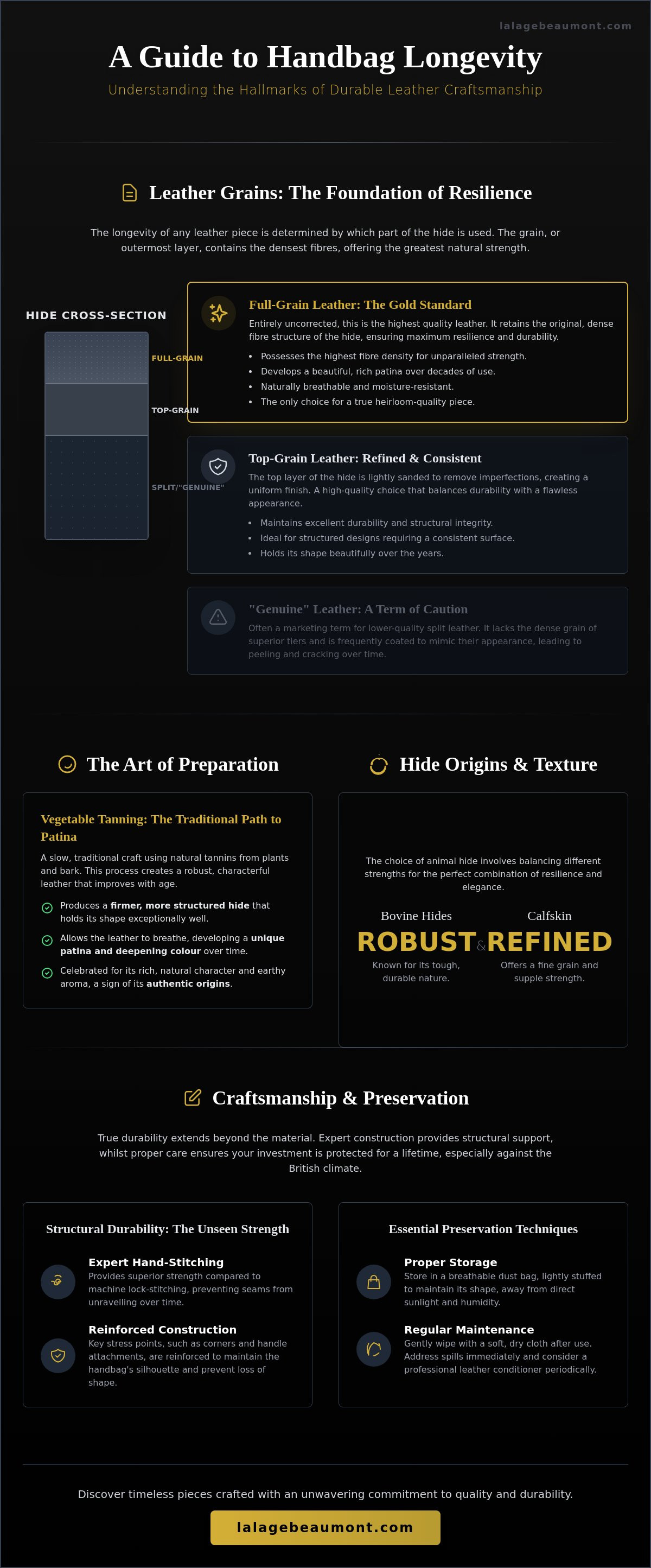
The journey to finding the perfect investment piece begins with an appreciation for the material's biological foundation. Leather is a complex organic structure; the longevity of any accessory depends almost entirely on which part of the hide is utilised. At the very top of the hierarchy sits full-grain leather, followed by top-grain, and finally, the often-misunderstood "genuine" or split leathers. Understanding these distinctions is paramount when seeking the best leather for handbags durability, as the structural integrity of the fibres varies significantly between these layers.
The outermost layer of the animal's skin, known as the grain, contains the densest and most tightly intertwined fibres. This natural density is what provides the hide with its inherent strength and resistance to punctures or tears. When this layer is left intact, the material remains robust and flexible. In contrast, inferior materials that have had this top layer removed often suffer from peeling or cracking, as the underlying fibres are far looser and more prone to saturation. For those who appreciate the finer details of Leather production, it's clear that grain integrity is the hallmark of a piece designed to last a lifetime.
Full-Grain: The Gold Standard for Resilience
Full-grain leather is prized for being entirely uncorrected. This means the surface hasn't been sanded or buffed to remove natural markings; instead, it retains the hide's original character and unparalleled strength. It's remarkably breathable and possesses a natural ability to resist moisture, which is particularly beneficial in the unpredictable British climate. Perhaps most importantly, full-grain is the only variety that develops a true patina over time. Rather than wearing out, it matures, becoming more beautiful and supple with every year of use. It is the essential choice for an heirloom-quality accessory.
Top-Grain and Corrected Leather: A Balancing Act
Whilst full-grain is the pinnacle of resilience, top-grain leather offers a refined alternative for certain handbag collections. This material undergoes a process where the very top layer is lightly thinned or sanded to create a more uniform, blemish-free appearance. It remains a high-quality choice, especially for structured, formal designs that require a consistent finish across large panels. It provides a sophisticated silhouette that holds its shape beautifully over the years.
You should, however, exercise caution when encountering the term "genuine leather" in a boutique. Despite its promising name, this is often a marketing term for the lower-tier splits of the hide. These layers lack the dense grain structure required for long-term resilience and are frequently coated in plastic-based finishes to mimic higher-quality grains. For the discerning collector, identifying the best leather for handbags durability means looking beyond labels and focusing on the tactile density of the grain itself.
Tanning Techniques: How Preparation Determines Durability
Whilst the grain determines the foundation of strength, the tanning process defines the character and environmental resilience of the material. Tanning is essentially the art of preserving a raw hide to prevent decay and ensure it remains supple for use. For those seeking the best leather for handbags durability, understanding how these treatments affect the leather's reaction to humidity and light is essential. According to technical documentation from the EPA on Leather Tanning, the process involves stabilising the collagen fibres, a step that has been further refined by the latest 2026 international standards for material resistance. These preparations dictate whether a hide will resist the elements or evolve with them.
Vegetable Tanning: The Traditional Path to Patina
This traditional method relies on natural tannins found in tree bark, fruits, and plants. It's a slow, unhurried craft that can take several weeks to complete, but the results are truly distinctive. The process produces a firmer, more robust hide that holds its shape exceptionally well amongst more architectural or structured designs. Vegetable-tanned leather is celebrated for its rich, woody scent and the way its colour deepens over time. Because it isn't sealed with heavy synthetic coatings, it reacts naturally to sunlight and handle, allowing it to develop a unique patina that reflects the life of its owner.
Chrome Tanning: Modern Flexibility and Colour Retention
In contrast, chrome tanning is a mineral-based process that offers a different set of advantages for the modern wardrobe. It produces a softer, more flexible leather that is often preferred for vibrant colours and "nappa" style finishes. This method provides superior water resistance and colour consistency, making it a practical choice for pieces that must withstand the humidity of the city whilst maintaining a pristine appearance. It's particularly suited for softer silhouettes that require a certain drape and ease of movement, ensuring the bag remains comfortable against the body.
A significant factor in longevity is how a tanned hide handles daily scuffs. High-quality tanning processes infuse the leather with oils and waxes that can migrate through the fibres. This allows the material to "self-heal" minor marks; a gentle buff with a soft cloth often redistributes these oils to mask superficial scratches. This inherent resilience ensures your accessory remains a source of pride for years to come. If you're considering a new addition to your collection, you might explore our collection of hand-crafted bags to see these tanning techniques in person.
Selecting the Right Hide: Animal Origin and Texture
Selecting the ideal hide is perhaps the most personal stage of the curation process. Whilst we've explored the foundations of grain and tanning, the animal's origin determines the tactile experience and structural weight of your accessory. Bovine leather remains a traditional favourite for substantial pieces, offering a thickness and weight that ensures a bag retains its silhouette. If you're seeking the best leather for handbags durability for a piece that must carry a laptop or heavy planners, a structured bovine hide is often the most reliable choice. It's naturally resistant to the scuffs of a daily commute and provides a reassuring sense of permanence.
The age of the animal plays a vital role in the hide's final characteristics. Younger skins, such as calfskin, possess a much tighter grain density. This results in a surface that's incredibly soft to the touch but surprisingly resilient to stretching. As detailed in the Modern Leather Making Guide, the specific biological structure of these skins allows for a refined finish that doesn't compromise on tensile strength. Texture also serves a functional purpose beyond aesthetics. Embossed leathers, such as mock-croc or lizard prints, undergo a heat-pressing process that further compresses the fibres. This often adds a protective layer, making them amongst the most durable options for those who worry about surface scratches.
Bovine Leather: The Robust Choice for Everyday Use
Cowhide is the quintessential material for the professional wardrobe. Its natural thickness provides a sturdy frame for larger bags that must maintain their shape whilst carrying daily essentials. It resists scratching remarkably well, making it a dependable partner for travel or busy city life. When you require a bag that can withstand being placed on various surfaces throughout the day, bovine leather offers the necessary peace of mind without sacrificing an air of sophistication.
Calfskin and Nappa: Softness Without Sacrificing Strength
There's a common misconception that a softer hide is inherently more fragile. In reality, premium calfskin is one of the most resilient materials available. Its fine grain is tightly packed, which provides exceptional strength despite its delicate appearance. This is why it's the preferred choice for iconic, structured pieces like the Fonteyn. Nappa finishes, which are particularly supple, remain robust because the integrity of the top-grain is meticulously preserved. Whether you're selecting a formal clutch or a sophisticated day bag, these leathers offer a graceful balance of luxury and longevity. We take great pleasure in helping our clients identify the specific hide that aligns perfectly with their personal style and professional needs.
Structural Durability: Why Construction Matters as Much as Material
A handbag's longevity is a delicate marriage between the quality of the hide and the precision of its assembly. Even when you've identified the best leather for handbags durability, the piece will only truly last if the construction supports the material's natural properties. A well-designed accessory should distribute weight evenly across its frame, preventing the leather from stretching or sagging prematurely. This structural integrity is particularly vital for bags that maintain a specific silhouette, as it ensures the piece remains as striking in ten years as it is today. It's the difference between a bag that ages with grace and one that loses its character after a single season.
One of the most significant markers of quality is the treatment of the edges. Professional edge-painting involves applying multiple layers of sealant to the raw cuts of the leather. This unhurried process protects the fibres from fraying and prevents moisture from seeping into the core of the hide. Without this protection, even the finest full-grain leather can begin to delaminate at the corners. It's these subtle, hand-finished details that distinguish a true investment piece from a mass-produced alternative. When the structure is firm, the leather doesn't have to work as hard to maintain its shape, which significantly reduces the risk of surface cracking at the points where the bag naturally flexes.
Hand-Stitching and Reinforcement Points
Hand-finished seams are essentially an insurance policy for your bag. Whilst modern machines are efficient, they can sometimes weaken the leather by creating a continuous perforated line. Traditional stitching methods often employ a technique that won't unravel even if a single thread is compromised. We pay particular attention to stress points such as handle attachments and strap loops. These areas require extra reinforcement to manage the tension of daily use, ensuring the leather doesn't tear under pressure. This commitment to detail is a hallmark of traditional British craftsmanship, where every stitch is placed with the intention of lasting a lifetime.
Hardware and Lining: The Internal Life of a Bag
The durability of a bag extends to its internal components and metalwork. We recommend looking for solid brass or high-grade steel hardware that won't flake or corrode over time. Similarly, a quality lining made from suede or silk ribbon provides a soft buffer that protects the leather from the inside out. Don't forget to check the base of the bag; protective metal "feet" are a simple but effective way to prevent scuffing when the piece is placed on different surfaces. If you're looking for a piece that embodies this level of detail, you may view our full range of structured leather handbags to find your next heirloom.
Preserving Your Investment: Professional Care for Leather Goods
Acquiring a piece crafted from the best leather for handbags durability is only the beginning of a lifelong journey. Whilst the inherent quality of the hide provides a robust foundation, the longevity of your accessory is ultimately secured through thoughtful stewardship. In the British climate, where humidity and sudden showers are frequent companions, a measured approach to maintenance is essential. We invite you to view your handbag not as a seasonal acquisition, but as a cherished companion that matures alongside you, gaining character with every year of attentive care.
Proper preservation ensures that the natural oils within the leather remain balanced. This prevents the fibres from becoming brittle or losing their original lustre. It's particularly important for structured pieces that rely on fibre integrity to maintain an architectural silhouette. By adopting a few simple rituals, you can protect your investment from the environmental factors that often lead to premature wear in lesser materials.
Daily Maintenance and Storage Rituals
Should you find yourself caught in a typical British downpour, act with grace and speed. Use a soft, dry cloth to gently wipe away any moisture as soon as you're indoors, allowing the bag to dry naturally away from direct heat sources. When your handbag is not in use, it should be stored in its protective dust bag to prevent light exposure and dust accumulation. We recommend stuffing the interior with acid-free tissue paper to preserve its original shape and prevent the leather from collapsing. For a more comprehensive look at these techniques, you might enjoy reading our guide on Handbag Care 101: Keeping Your Leather Pristine.
Professional Care and Long-Term Value
Whilst daily rituals are effective, there comes a time when a professional "refresh" service is the most responsible course of action. Professional artisans possess the expertise to deep-clean the grain and replenish essential nutrients without compromising the leather's structural integrity. This is especially true for delicate calfskin or nappa finishes that may require specialist conditioning to maintain their suppleness. Seeking expert assistance every few years ensures that your collection remains in impeccable condition, ready to be passed down amongst future generations.
The true ROI of selecting the best leather for handbags durability lies in this ability to endure. Choosing one high-quality piece over a succession of cheaper alternatives is a testament to ethical endurance and a commitment to craftsmanship. It's a sustainable choice. This approach rewards the owner with a sense of security and timeless elegance. We take great pleasure in assisting our clients with the ongoing care of their pieces, ensuring that each bag remains a testament to refined taste for decades to come.
Investing in a Legacy of Craftsmanship
Selecting an investment piece is an unhurried process of identifying the harmony between natural material and expert assembly. You now understand that the best leather for handbags durability relies upon the dense fibres of full-grain hides and the stabilising influence of traditional tanning. When these superior materials are met with the precision of hand-stitched seams and reinforced stress points, the result is an accessory that doesn't merely endure; it matures with a unique grace that reflects your personal journey.
We invite you to experience this dedication to quality firsthand. Our pieces are hand-stitched by expert artisans and are available in a curated variety of vibrant, durable hides that feel as exquisite as they look. Whether you're preparing for a prestigious seasonal event or seeking a dependable partner for your professional wardrobe, we'd be delighted to assist you. You're most welcome to visit our flagship boutiques in Knightsbridge and Burlington Arcade to explore our collection of handcrafted leather handbags designed for a lifetime of elegance.
Choosing quality over fleeting trends is a commitment to sustainability and heritage. We look forward to helping you find a companion that will be cherished for many years to come.
Frequently Asked Questions
Which leather is most resistant to scratches for a daily handbag?
Embossed bovine leathers, such as mock-croc or lizard prints, provide the greatest resistance to surface scratches. The heat-pressing process used to create these textures compresses the fibres and creates a hardened surface that handles daily wear with ease. Whilst smooth leathers are beautiful, they tend to show marks more readily than these textured alternatives.
Is calfskin more durable than cowhide for structured bags?
Calfskin and cowhide are both exceptionally durable, but they offer different benefits. Cowhide is thicker and heavier, making it ideal for large totes that carry significant weight. Calfskin, however, possesses a much tighter grain density, which provides incredible tensile strength in a lighter, more refined form. It's often the preferred choice for structured handbags that require a sophisticated silhouette.
How do I know if a handbag is made from real full-grain leather?
You can identify full-grain leather by its unique, non-repeating grain pattern and the presence of subtle natural markings. It should feel substantial and warm to the touch rather than cold or plastic-like. Unlike corrected leathers, full-grain will develop a rich patina over time, whereas inferior materials will simply peel or crack as they age.
Does vegetable-tanned leather require more maintenance than chrome-tanned?
Vegetable-tanned leather does require a more attentive care routine as it's more sensitive to water and sunlight. It benefits from regular conditioning to keep the fibres supple and prevent drying. Chrome-tanned leather is generally more resilient to moisture and maintains its original colour with less frequent intervention, making it a practical choice for a busy lifestyle.
Can a scratched leather bag be repaired to its original state?
Minor surface scratches can often be diminished by gently buffing the area with a soft cloth to redistribute the hide's natural oils. For deeper marks that have compromised the grain, professional restoration is the most reliable solution. A skilled artisan can often clean and pigment the area to restore the bag's pristine appearance without losing its character.
What is the best way to protect a leather bag from rain and water stains?
The best defence is a combination of preventative conditioning and swift action. Applying a high-quality leather cream creates a subtle barrier against moisture. If your bag is exposed to rain, wipe it immediately with a soft cloth and allow it to dry naturally at room temperature. Never place it near a radiator, as this can cause the leather to become brittle.
Why is full-grain leather considered the best for durability?
Full-grain is the best leather for handbags durability because it preserves the strongest part of the hide. The outermost layer contains the most densely intertwined fibres, which provides natural resistance to punctures and stretching. By keeping this layer intact, the leather remains robust and capable of withstanding decades of use without losing its structural integrity.
How long should a high-quality leather handbag realistically last?
A handbag crafted from premium hides and assembled with expert techniques should realistically last for thirty years or more. These pieces are designed to be heirloom assets rather than disposable fashion. With professional care and proper storage, a well-made bag will serve as a faithful companion through many decades and can eventually be passed down amongst family members.