


The most significant threat to your collection isn't the occasional rain shower or a busy morning commute, but the quiet, unseen environment of your own wardrobe. It's a common worry for any collector; the sight of a beloved piece losing its poise or the discovery of a faint scuff caused by poor placement is truly disheartening. Learning exactly how to store luxury handbags at home is essential if you wish to maintain the impeccable silhouette and finish of your leather investments for decades to come.
We believe that caring for your leather is a gesture of respect for the craftsmanship involved. In this guide, we'll share the professional secrets to preserving the beauty and structure of your finest pieces through meticulous care. You'll discover a manageable routine that prevents hardware tarnish and colour transfer, whilst turning your dressing room into an organised, aesthetically pleasing sanctuary. From the ideal humidity levels to the subtle art of internal support, we'll provide the confidence you need to ensure your collection remains a timeless and dependable part of your professional wardrobe.
Key Takeaways
- Learn why removing surface oils and emptying every pocket is a prerequisite for preventing permanent leather discolouration and internal lining distortion.
- Discover the essential techniques for how to store luxury handbags at home using internal support to combat gravity and prevent the formation of permanent creases.
- Understand how to safeguard your collection against the drying effects of British central heating by maintaining a stable, temperate environment.
- Recognise why breathable cotton dustbags are superior to synthetic blends for preserving the natural suppleness and finish of fine leather.
- Establish a graceful quarterly inspection routine that ensures your pieces are perfectly prepared for the upcoming events on the British social calendar.
The Essential Preparation: Cleaning and Assessment Before Storage
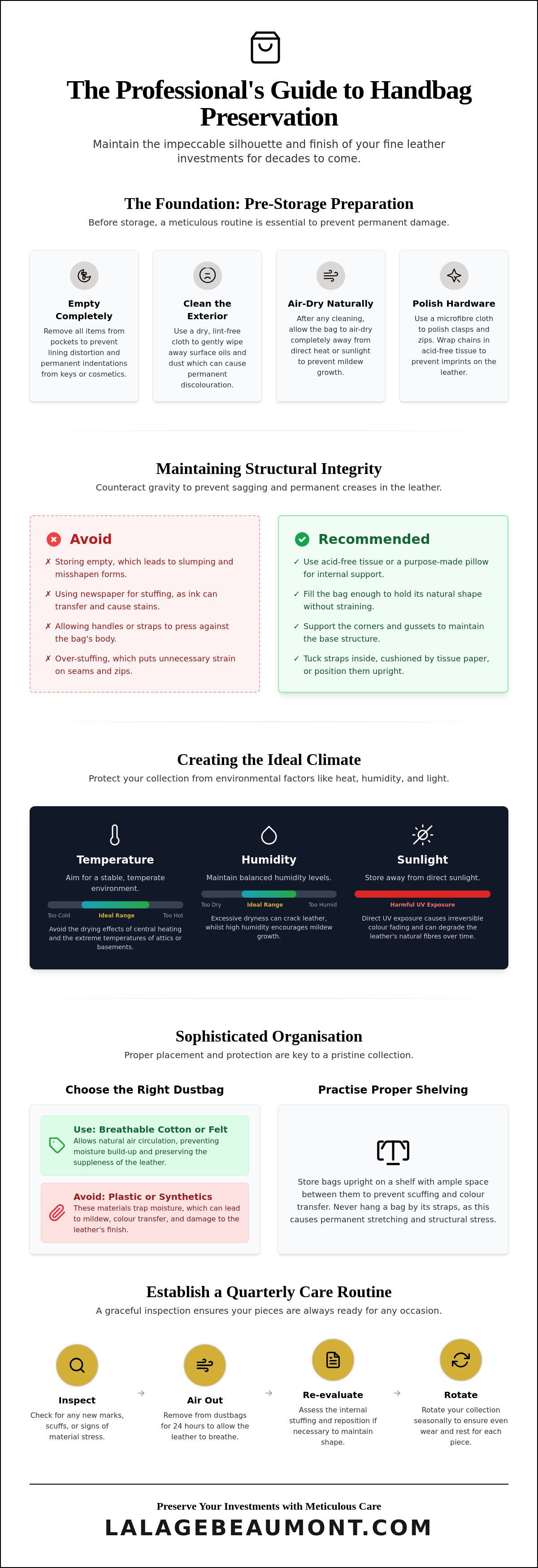
Before a piece is retired to the sanctuary of your wardrobe, it requires a moment of dedicated stewardship. Understanding how to store luxury handbags at home begins long before the bag reaches the shelf; it starts with a meticulous assessment of its current state. Storing a bag that still carries the day's surface oils or atmospheric dust is a recipe for permanent discolouration. These oils, often from hand creams or natural skin contact, can oxidise over time and seep into the pores of the leather, leading to dark patches that are remarkably difficult to reverse.
Adhering to the principles of leather conservation ensures that the organic nature of the material is respected. Leather is a porous, breathing skin; it reacts to its environment. Before placing your leather handbags into storage, ensure every pocket is completely empty. Lingering items, such as a heavy set of keys or a stray lipstick, can cause the lining to stretch or create permanent indentations in the exterior leather. If left for months, these distortions become part of the bag's memory, making them nearly impossible to smooth out later.
A gentle wipe-down is the next essential step. Use a clean, dry, lint-free cloth to lift away dust and pollutants. If a slightly damp cloth is necessary for a specific mark, ensure it's only marginally moist. Over-saturating the leather can strip away its natural finish or cause water spotting. Once cleaned, allow the bag to air-dry naturally in a temperate room away from direct heat or sunlight. Covering a bag that retains even a hint of moisture is an invitation for mildew, which can ruin a fine investment overnight.
Surface Cleaning and Interior Assessment
Begin by gently shaking the bag upside down over a soft surface to dislodge any loose debris. Where the design allows, pull the fabric lining outwards to inspect the corners. Dust and lint tend to gather in these crevices; if left, they can become ground into the fabric. Ensure the interior is completely dry and free from any scents, such as spilt perfume, which could become concentrated whilst the bag is enclosed in its dustbag.
Addressing Hardware and Metalwork
The metalwork on your bag deserves as much attention as the leather itself. Use a microfibre cloth to polish clasps and zips, removing fingerprints that might cause tarnish. It's often wise to wrap heavy chains or charms in acid-free tissue paper. This prevents the metal from pressing against the leather and leaving a permanent mark. Always ensure zips are closed or neatly tucked away. An exposed zip tooth can easily scratch the delicate surface of an adjacent bag in a crowded wardrobe.
Maintaining Structural Integrity: The Art of Stuffing and Shaping
Gravity is the silent adversary of any structured accessory. When a bag is left to sit empty for extended periods, the weight of the leather inevitably causes it to sag, leading to a loss of its original architectural poise. This isn't merely a temporary aesthetic issue; leather possesses a physical memory. Once a crease or fold becomes established in the hide, it's remarkably difficult to remove. Mastering how to store luxury handbags at home involves understanding how to counteract this downward pull by providing internal support that mimics the bag's natural silhouette.
Achieving the perfect fill requires a delicate touch. You aren't simply cramming the interior with material; you're creating a bespoke internal skeleton. Start by placing support at the very bottom corners and along the gussets. These are the foundations that hold the bag’s footprint. For handcrafted leather handbags UK enthusiasts, maintaining the crisp lines of a firm silhouette is often the highest priority. A well-stuffed bag should look exactly as it does when it's in use, full but never strained.
Handles and straps require their own strategy. If left to rest against the body of the bag, the weight of a heavy handle or a metal chain can leave a permanent imprint on the supple leather. Where possible, tuck straps inside the bag, perhaps cushioned by a layer of tissue. If the handles are rigid, ensure they're positioned so they don't lean against the leather surface. This meticulous attention to detail is a cornerstone of protecting your handbag investment and ensures that each piece in your collection remains as striking as the day it was first acquired.
Choosing the Right Filling Materials
Prioritise materials that respect the organic nature of the leather. Acid-free tissue paper is the gold standard, as it won't cause chemical reactions or yellowing over time. Avoid newsprint or coloured papers at all costs; the ink can easily transfer to the lining, especially in humid conditions. For a more luxurious touch, you might use clean silk scarves or spare cotton dustbags. These materials are breathable and soft, providing support without the risk of abrasion.
Avoiding Overstuffing and Distortion
The Gentle Resistance test is your most reliable guide. When you press against the exterior of the stuffed bag, there should be a slight give before you feel the internal support. If the seams look tight or the leather appears taut, you've used too much filling. Overstuffing is just as damaging as under-stuffing, as it can permanently stretch the leather or weaken the stitching. If you're looking to expand your collection with pieces designed for longevity, you might explore our range of structured handbags that are crafted to hold their form beautifully.
Creating the Ideal Environment: Protecting Against the British Climate
The British climate presents a unique set of challenges for the discerning collector, where the dampness of the seasons often clashes with the dry intensity of modern central heating. To preserve the suppleness of your collection, you must aim for the "Goldilocks" zone: an environment that is neither too arid nor too humid. Leather is an organic material that breathes; when the air becomes too dry, particularly during the winter months when radiators are active, it can strip the natural oils from the hide. This leads to brittleness and, eventually, irreversible cracking. Conversely, excessive moisture encourages the growth of mildew, which can settle into the pores of the leather and cause permanent damage.
When considering how to store luxury handbags at home, consistency is your most valuable ally. Many collectors find that placing a discreet hygrometer in their dressing room provides the necessary data to maintain an ideal humidity level. Research suggests that keeping relative humidity between 30% and 40% is effective for preventing the growth of mould and mildew. If you discover your wardrobe is prone to dampness, a small dehumidifier can be a wise investment to stabilise the atmosphere. We find that a measured, proactive approach to climate control is the surest way to guarantee the longevity of your finest pieces.
Managing Humidity and Dampness at Home
Airflow is the simplest yet most effective defence against moisture. Ensure there is a small gap between the back of your shelving and the wall to allow air to circulate freely. One must never store fine leather in plastic bins or non-breathable containers. These trap moisture and create a micro-climate that invites mould. Instead, consider using cedarwood blocks or natural silica packets to absorb any lingering dampness. These subtle additions help maintain a crisp, dry environment without the need for aggressive chemicals, ensuring your pieces remain in pristine condition whilst out of use.
Light Exposure and Temperature Control
Position your handbags away from direct window light and radiators. UV rays are the primary culprit behind colour fading, particularly for vibrant or dyed leathers. The impact of light varies across different types of leather; however, prolonged exposure will eventually dull even the most resilient finish. Temperature also plays a vital role in preservation. Avoid the top shelf of a wardrobe if it sits directly beneath a warm ceiling or near a heating vent, as this is often the warmest spot in the room. A cool, dark, and well-ventilated space is the ultimate sanctuary for your investment pieces.
Sophisticated Organisation: Shelving, Dustbags, and Spatial Planning
A truly refined dressing room balances aesthetic elegance with the practicalities of preservation. Once you've mastered the environmental basics, discovering how to store luxury handbags at home becomes a matter of spatial geometry and material choice. The way a bag is positioned on a shelf can be just as impactful as the temperature of the room. When bags are crowded together, they risk "kissing," a term used by curators to describe when two leather surfaces touch for extended periods. This can lead to permanent colour transfer or hardware indentations that diminish the piece's flawless finish.
Organising your collection by size or silhouette isn't merely for visual satisfaction; it minimises unnecessary handling. By placing your most frequently used pieces at eye level and seasonal items on higher, deeper shelves, you reduce the risk of accidental scuffs whilst reaching for a specific bag. We recommend using smooth shelf dividers made of glass or polished wood to keep each item upright. These dividers ensure that even the softest clutch or the most structured tote remains in its designated space, preventing the weight of one bag from distorting the shape of its neighbour.
View our curated collection of handcrafted handbags to see the variety of silhouettes that benefit from these meticulous storage techniques.
The Role of the Breathable Dustbag
The choice of material for your dustbag is paramount. Always prioritise 100% cotton over synthetic blends. Cotton allows the leather to breathe, preventing the buildup of gases that can cause the hide to "sweat" or the natural oils to go rancid. It's best to use the original neutral-coloured dustbag provided at the time of purchase, as these are sized specifically for the piece. If you've misplaced the original, ensure the replacement is white or cream to avoid any risk of dye migration. To identify your pieces without opening every bag, consider attaching a small, acid-free card tag to the drawstring with a brief description or a small photograph.
Shelving vs. Hanging: The Verdict
Whilst it may be tempting to display your collection by hanging it from hooks, this is a practice to be avoided for long-term storage. Hanging a bag by its handles or straps puts immense, constant tension on the leather and the stitching. Over months, this leads to "strap stretch," a permanent lengthening and thinning of the leather that ruins the bag's proportions. The only exception is a very lightweight silk clutch. For everything else, flat shelving is the gold standard. Smooth surfaces like glass or lacquered wood are ideal, as they don't catch on delicate leather bases. This creates a boutique-like atmosphere in your home whilst ensuring the structural integrity of your investment remains uncompromised.
Seasonal Rotation and Professional Care for Investment Pieces
A well-curated collection is a living entity that evolves with the seasons. Whilst the previous chapters have focused on the technicalities of how to store luxury handbags at home, the final stage of stewardship involves aligning your wardrobe with the rhythm of the British social calendar. This seasonal rotation isn't merely a logistical necessity; it's an opportunity to conduct a Quarterly Inspection. Every three months, we recommend removing each piece from its dustbag to assess its condition. Look for signs of leather fatigue, such as a slight loss of lustre or stiffness in the gussets. This proactive habit ensures that small issues are addressed before they require significant intervention.
Surprisingly, one of the best ways to preserve a bag is to use it. Leather is a natural material that benefits from occasional movement; the gentle flexing of the hide during use helps to distribute natural oils and maintain suppleness. When a piece is retired for the season, ensure its accompanying accessories are also cared for. Before storing your summer silk ribbon scarves, check for any lingering perfume or oils that could damage the fabric or the leather of the bag they were once tied to. We take great pleasure in assisting our clients with these finer details of wardrobe maintenance.
Organising for the Social Calendar
Efficiency in your dressing room is achieved by grouping your collection according to the events they serve. Occasion bags for summer weddings or race days should be stored separately from your daily professional totes. As the festive season approaches, ensure your evening clutches are moved to a more accessible position. It's often helpful to coordinate your hats and other formal accessories in adjacent storage areas. This logical arrangement reduces the time spent searching for the perfect match, allowing you to focus on the joy of the event itself.
When to Seek Professional Refurbishment
There are moments when home care reaches its limit. If you notice stubborn stains that home methods cannot reach, or if the leather begins to show significant scuffs, it's time to seek expert help. Professional leather cleaning services in the UK often start from approximately £25, whilst a more comprehensive colour restoration for a cherished vintage piece can begin at £150. Entrusting your investment to a specialist ensures that the craftsmanship is respected and the heritage of the piece is preserved for future generations. It's a small price to pay for the peace of mind that your collection remains in impeccable condition.
Preserving the Legacy of Fine Craftsmanship
Your collection is a testament to personal style and a deep appreciation for the finer things in life. By maintaining a stable environment with controlled humidity and ensuring each piece is supported by acid-free materials, you're doing more than just tidying a wardrobe. You're actively participating in the preservation of heritage. Mastering how to store luxury handbags at home is a rewarding ritual that transforms a simple dressing room into a curated gallery of your finest investments. These small, deliberate acts of care ensure that the leather remains supple and the silhouette remains as poised as the day it was first crafted.
Every piece in our collection is handcrafted in London and Italy with meticulous attention to traditional craftsmanship. These items are designed for longevity and timeless elegance; they're intended to be cherished for a lifetime and passed down to future generations. We invite you to explore our collection of handcrafted leather handbags and discover the perfect addition to your professional wardrobe. With these professional secrets at your disposal, you can proceed with the quiet confidence that your most valued pieces will remain beautiful and dependable for decades to come.
Frequently Asked Questions
Should I store my handbags in their original boxes?
Storing your pieces in their original boxes is generally discouraged because it restricts essential airflow and can trap humidity. Whilst boxes are beautiful for presentation, they create a stagnant environment that may encourage mildew. Instead, we recommend using a breathable cotton dustbag on a flat shelf. This method provides the necessary protection from dust whilst allowing the hide to breathe naturally, which is a fundamental principle of how to store luxury handbags at home.
How often should I take my handbags out of storage to "breathe"?
We suggest removing your pieces from their dustbags at least once every quarter. This "breathing" period allows you to inspect the leather and ensures that no moisture has become trapped within the folds. It's a perfect time to conduct the seasonal rotation mentioned earlier, ensuring each bag in your collection remains supple and ready for the next prestigious event on your social calendar.
Can I use bubble wrap to stuff my leather bags?
You should avoid using bubble wrap or any plastic-based materials for internal stuffing. Plastic is non-breathable and can trap moisture against the leather, potentially leading to mould or a sticky residue. Acid-free tissue paper or clean silk scarves are the preferred choices. These materials provide excellent structural support whilst respecting the organic nature of the leather, ensuring the silhouette remains pristine without the risk of chemical reactions.
What is the best way to store a handbag with a long chain strap?
The most effective way to store a chain strap is to gently tuck it inside the bag's interior. Before doing so, wrap the chain in acid-free tissue paper to prevent the metal from scratching the lining or indenting the exterior leather. This technique is a vital part of how to store luxury handbags at home, as it protects both the hardware and the delicate hide from unnecessary pressure marks during periods of inactivity.
How do I prevent my leather bags from smelling musty in the wardrobe?
Preventing musty odours requires a combination of airflow and humidity control. Ensure your wardrobe isn't overcrowded and keep a small gap between the shelving and the wall. Using natural silica packets or a discreet dehumidifier can help maintain the ideal humidity level of 30% to 40%. If a bag already smells slightly damp, allow it to air-dry in a temperate room before returning it to its protective dustbag.
Is it safe to use mothballs near my leather handbag collection?
It is not safe to use mothballs near your leather collection. The pungent chemicals can be absorbed by the porous leather, leaving a persistent odour that is almost impossible to remove. Additionally, the fumes may react with certain leather finishes or metal hardware. For a safer, more pleasant alternative, consider using natural cedarwood blocks or lavender sachets to keep your dressing room fresh and protected.
Should I condition my bag before putting it away for the season?
Conditioning is beneficial if the leather feels particularly dry, but it must be done with caution. Apply a small amount of high-quality cream and allow it to be fully absorbed for at least 24 hours before storage. Putting a bag away whilst the conditioner is still damp can trap moisture and attract dust. A well-conditioned bag is far more resilient to the drying effects of central heating during the winter months.
What should I do if I find a small scratch on the leather before storing it?
If you discover a small scratch, you should clean the area gently with a dry cloth before deciding on a treatment. Minor surface scuffs can often be buffed out with a specialised leather balm. However, if the scratch is deep, it's best to consult a professional restoration service before long-term storage. Storing a damaged bag can allow the leather to dry out further around the tear, making a future repair more complex.