


A high price tag is often the least reliable indicator of a handbag's true worth. It's a common frustration to invest in a piece only to find the edges peeling or the shape sagging after a single season. We understand the hesitation that comes with choosing a new accessory, especially when you wish to ensure your investment reflects genuine craftsmanship rather than a fleeting trend. By learning the specific signs of a well-made handbag, you can move past the surface aesthetic and appreciate the structural integrity that defines a true heirloom.
We're delighted to share the technical secrets that separate masterfully crafted pieces from mass-produced alternatives. In this guide, we'll explore the nuances of full-grain leather and the importance of consistent, high-tension stitching. You'll learn how to evaluate the weight and finish of hardware whilst ensuring every zip and clasp operates with a satisfying, smooth precision. Our aim is to provide you with the confidence to select a piece that will age gracefully and remain a favourite staple of your wardrobe for many years to come.
Key Takeaways
- Identify the structural hallmarks of full-grain leather to distinguish lasting quality from temporary fashion.
- Master the art of inspecting stitch density and tension, which are critical signs of a well-made handbag.
- Recognise the superior durability of solid brass hardware and smooth-gliding metal zips compared to mass-produced alternatives.
- Appreciate how small-batch British craftsmanship and traditional techniques contribute to the longevity of your favourite accessories.
- Gain the confidence to evaluate a piece based on its technical integrity and material excellence rather than its label.
Defining Handbag Quality Beyond the Label
True quality is often found in the quietest details. Whilst a high price tag might suggest excellence, it frequently reflects marketing budgets rather than material costs. Discerning customers look for signs of a well-made handbag in the grain of the leather and the weight of the metal. Identifying these markers allows you to invest with confidence, ensuring your choice is based on tangible craftsmanship rather than a temporary name. When you prioritise material integrity, you're choosing a piece that will retain its beauty and functional value long after seasonal trends have faded.
The current shift towards understated elegance isn't a mere trend; it's a return to the fundamental values of craftsmanship. When logos are absent, the bag must speak through its silhouette and finishing. Understanding the history and types of handbags reveals that the most enduring designs have always prioritised function and form over overt branding. By focusing on the structural components, you can distinguish between a trend-led accessory designed for a single season and a timeless staple that serves as a cornerstone of a professional wardrobe.
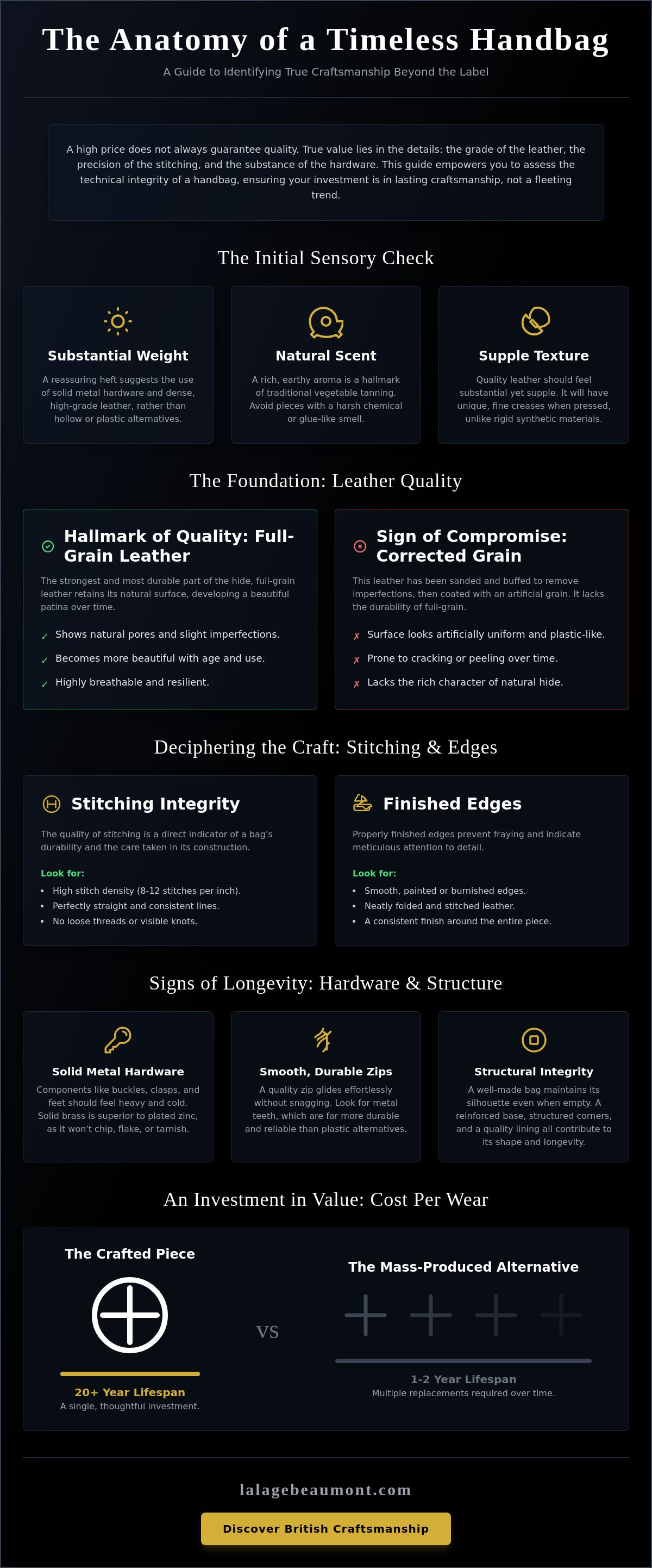
An investment piece should be viewed through the lens of cost per wear. A poorly constructed accessory might lose its shape or show signs of fraying within months, necessitating a replacement. In contrast, a superior item maintains its elegance for decades. This makes a handcrafted leather bag a more sustainable and economical choice in the long term. It's a commitment to "buying better," which honours both the artisan's skill and the environment.
The Philosophy of the Investment Piece
Longevity is the ultimate marker of luxury. A well-constructed bag shouldn't just survive twenty years; it should develop a beautiful patina that tells a story of its use. We recommend focusing on classic silhouettes, such as structured totes or elegant top-handle designs, which remain relevant despite shifting fashion cycles. Choosing quality over quantity is the cornerstone of a thoughtful, sustainable wardrobe. It ensures that every item you own is a favourite you can rely on for any significant life event.
Initial Sensory Checks: Weight, Scent, and Texture
Before examining the finer details, trust your senses. A quality bag has a certain "heft" that feels intentional. This weight usually indicates the presence of solid metal components and dense, high-grade leather rather than hollow plastics or thin skins. The scent should be rich and earthy, a hallmark of traditional tanning processes. If a bag smells of harsh chemicals or glue, it's often a sign of rushed production. Finally, the "hand-feel" should be supple yet substantial, offering a tactile satisfaction that synthetic alternatives simply cannot replicate.
The Foundation of Excellence: Leather Grades and Lining
Quality begins with the hide. One of the most telling signs of a well-made handbag is the grade of leather used for its construction. Whilst many manufacturers opt for corrected-grain skins to ensure a uniform appearance, the true connoisseur seeks the natural character found in full-grain leather. This grade represents the top layer of the hide, where the fibres are most dense and durable. According to data from Selina Wamucii, the price of leather reached $2.16 per kg in June 2026. This represents a 22.1% increase that reflects the growing global demand for premium raw materials. Investing in such quality ensures your piece will develop a rich patina rather than simply wearing out.
The tanning process also dictates the longevity of the piece. Vegetable tanning, which utilises tannins found in tree bark and plants, remains a hallmark of traditional craftsmanship. This method is unhurried and kinder to the environment than chemical-heavy chrome tanning. It results in a leather that smells earthy and feels substantial. When exploring exotic textures, experts often look for specific anatomical markers, such as those used for distinguishing crocodilian leathers, to ensure the material meets the highest standards of authenticity and aesthetic grace.
Identifying Premium Leather Grades
Discerning the quality of a skin requires a keen eye for detail. You should look for natural pores and slight imperfections; these aren't flaws but rather proof of full-grain authenticity. You can perform a simple "wrinkle test" by gently pressing the surface. Genuine leather will show unique, fine creases that disappear when released. Bovine leather is particularly favoured for handcrafted leather handbags UK because it offers the superior structure and resilience needed for formal silhouettes. Should you wish to experience this rigidity and grace, we invite you to view our latest collection of structured bags.
The Interior: A Hidden Quality Marker
A bag's interior should never be an afterthought. High-quality linings are typically made from natural fibres like silk, suede, or dense cotton twill. These offer a tactile luxury that synthetic polyester lacks. Check if the lining is securely bonded to the outer shell or if it "floats" loosely; a bonded lining indicates a more rigorous construction process. Internal pockets should be reinforced at the stress points with additional stitching or leather trim. We often recommend choosing a lighter-coloured lining. It improves visibility and makes it easier to find your essentials amongst your belongings during a busy day.
Deciphering the Craft: Stitching, Edges, and Finishing
The integrity of a piece is held together by its seams. One of the most critical signs of a well-made handbag is the precision and density of the stitching. A higher stitch count, measured as stitches per inch (SPI), usually indicates rigorous attention to detail. In premium craftsmanship, you'll typically find between 8 and 12 stitches per inch. Sparse or uneven stitches are shortcuts taken in mass production. They compromise the bag's strength. It's a detail that many overlook, but it's vital for longevity.
Traditionalists often look for the saddle stitch. This hand-sewn technique involves two needles passing through the same hole from opposite sides. It's incredibly durable. If a single thread breaks, the other remains intact to hold the seam. Machine lock-stitches, by contrast, can unravel like a zip if the thread is caught. You can identify hand-stitching by its slight, characteristic slant. It's a mark of patience and heritage. The tension should be consistent; the thread shouldn't look loose or buried too deep into the skin.
The Anatomy of a Perfect Stitch
Inspect the stress points where the handles meet the body. You should see "back-stitching"—a double layer of thread that prevents the seam from unravelling under the weight of your essentials. The tension must be uniform throughout. If the thread looks uneven, the structural integrity is weakened. Contrast stitching is the ultimate test. It leaves no room for error, as every stitch is highlighted against the leather's surface. It's a bold statement of a craftsman's confidence in their work.
Edge Finishing: The "Melted" Look
The treatment of raw leather edges reveals much about the maker's dedication. Premium handbags frequently feature edge painting. This process requires multiple layers of paint, each sanded and buffed by hand until they form a smooth, resilient barrier. The finish should look "melted" into the leather. Avoid pieces where the paint looks thin or shows signs of cracking. For a more traditional look, turned edges—where the leather is thinned and folded over itself—offer a clean, sophisticated profile that's perfect for formal occasions.
Symmetry is non-negotiable in a high-quality piece. Seams must meet with mathematical precision at every corner. If a bag features a specific grain or texture, the pattern should align seamlessly across the panels. It's a subtle harmony that signals a truly superior piece. When patterns meet perfectly, it shows the artisan didn't just cut the leather to save material; they cut it to preserve the beauty of the design.
Hardware and Structure: Signs of Longevity
The metalwork on a piece is often described as its jewellery. It provides both aesthetic charm and vital structural support. One of the most reliable signs of a well-made handbag is the use of solid brass rather than plated zinc or hollow alloys. Solid brass is dense and heavy; it offers a reassuring weight that synthetic alternatives cannot match. Whilst plated metals often chip or peel over time to reveal a duller core, high-quality brass ages with grace. It develops a subtle patina that enhances the bag’s character. Current trends in 2026 show a particular prominence for silver-toned hardware and vintage-inspired, ornate designs. These elements must be executed with precision to ensure they don't snag delicate fabrics like silk shift dresses or tweed.
Functionality is just as important as finish. A premium metal zipper should offer a smooth, consistent glide without catching or requiring force. This effortless movement is a testament to the teeth being individually polished before assembly. You should also look for the presence of base studs, often called "feet." These small metal additions protect the leather from abrasive surfaces when the bag is placed down. They are a simple yet essential detail that significantly extends the life of the piece. It's these thoughtful touches that distinguish a true investment from a temporary fashion accessory.
Hardware That Ages Gracefully
The way hardware is attached speaks volumes about the maker's commitment to longevity. Discerning eyes look for screws rather than rivets; screws allow for professional repair should the need arise. The "gate" of a clasp should feel firm and snap shut with a distinct, heavy click. This sound is a hallmark of quality. It indicates that the internal springs and components are built for thousands of cycles of use without failing. High-quality hardware shouldn't just look beautiful on the day of purchase; it should remain functional for decades.
Reinforcement and Load-Bearing
A bag's beauty should be more than skin deep. True quality involves invisible reinforcements that help the piece maintain its silhouette even when empty. Internal stays and supports prevent the leather from sagging under the weight of your daily essentials. These internal features are often the hidden signs of a well-made handbag that ensure the piece remains a staple of your wardrobe. Handle attachments are particularly critical. They should be reinforced with additional layers of leather or discreet metal plates to distribute the load. We take immense professional joy in crafting pieces that stand the test of time. We invite you to explore our collection of structured handbags to see these hallmarks of quality for yourself.
Investing in British Craftsmanship and Artistry
Regionality is often a silent seal of excellence. Whilst mass-market production relies on speed and volume, small-batch manufacturing in England or European artisanal workshops prioritises the individual integrity of every piece. This unhurried approach ensures that the subtle signs of a well-made handbag are present in every seam and fold. The UK handbag market generated $3.1 billion in revenue in 2025 and is projected to reach $4.67 billion by 2033. This growth reflects a significant shift amongst discerning clients who value the longevity of local artistry over the transience of global fashion cycles. Choosing a piece made in a traditional workshop is a commitment to preserving heritage skills that have been refined over generations.
The bespoke experience is a hallmark of true luxury. It's about more than just the final product; it's the professional assistance and personal care you receive throughout the selection process. We find a genuine pleasure in serving clients who seek a deeper connection to their wardrobe. When you step into a refined boutique environment, the attentiveness of the staff should mirror the quality of the garments on display. This level of hospitality creates an atmosphere of trust, ensuring you feel confident that your investment is supported by experts who understand the nuances of fine leatherwork.
The Artisan’s Touch
Understanding the heritage behind the various types of leather used in London workshops is essential for any connoisseur. Each skin requires a different set of skills to manipulate and finish. Supporting local craftsmen also has profound ethical implications. It ensures fair wages and reduces the environmental impact associated with long-distance shipping. The attention to detail found in a small-batch piece, from the hand-painted edges to the reinforced handles, is a direct result of the artisan's personal accountability for their work.
The Final Inspection
Before making your final choice, we recommend a disciplined five-minute inspection. This ensures you've identified all the signs of a well-made handbag. Place the bag on a flat surface to check its symmetry from both the front and the side; it should stand perfectly upright without leaning. Open and close every clasp and zip three times to ensure the movement is effortless and the sound is a reassuring, heavy click. Finally, turn the bag over to inspect the base studs and the tension of the corner stitching. We invite you to discover the pinnacle of handcrafted elegance within the Lalage Beaumont handbag collection, where every piece is a testament to timeless British style and superior craftsmanship.
Embracing a Lifetime of Elegance
You now possess the knowledge to look beyond the surface and appreciate the structural artistry of a truly superior accessory. By prioritising material integrity and technical precision, you ensure that your choice is an investment in longevity rather than a fleeting trend. Recognising these signs of a well-made handbag allows you to build a wardrobe that reflects a deep commitment to quality and traditional craftsmanship. It's a shift in perspective that values the artisan's skill as much as the final silhouette.
Our pieces are handcrafted in prestigious artisan workshops, designed specifically for those who appreciate timeless British elegance and require accessories that endure a busy social calendar. We take great professional joy in providing pieces that serve as dependable partners for your most significant life events. We invite you to Explore the Handcrafted Handbag Collection and discover the perfect addition to your ensemble. We're ready to assist you in selecting an heirloom that you'll cherish for many years to come.
Frequently Asked Questions
How can I tell if a handbag is made of real leather?
Genuine leather is best identified through its unique scent and tactile response. It should possess a rich, earthy aroma whilst synthetic alternatives often emit a sharp, chemical odour. You may also perform the wrinkle test; real skins show fine, organic lines when pressed that vanish once released. These natural pores and slight variations are proof that the material has not been overly processed or replaced by plastic-based imitations.
Is a heavy handbag a sign of better quality?
A degree of "heft" is often one of the reliable signs of a well-made handbag. This weight typically indicates the use of solid brass hardware and dense, full-grain leather rather than hollow alloys or thin, bonded materials. Whilst a lighter bag is convenient for travel, a quality piece feels substantial and balanced in your hand, suggesting it has the internal reinforcements necessary for a long life.
What is the most durable type of leather for an everyday bag?
Bovine leather remains the most resilient choice for daily use due to its dense fibre structure. It offers exceptional durability and resistance to wear whilst maintaining its shape over time. For maximum longevity, seek out full-grain options that haven't been thinned or corrected; these skins are the strongest part of the hide and naturally age into a beautiful patina rather than wearing out.
Why do some expensive bags have "painted" edges?
Edge painting is a traditional technique used to seal raw leather edges and provide a smooth, sophisticated finish. This process requires multiple layers of specialised paint, each carefully sanded and buffed by hand until they form a seamless bond. When executed correctly, it creates a resilient barrier that prevents moisture from entering the leather and adds a refined, "melted" look to the bag's silhouette.
How many stitches per inch should a luxury bag have?
A high-quality accessory should typically feature between 8 and 12 stitches per inch. This density ensures the seams are robust and less likely to pull apart under the weight of your daily essentials. Consistent, tight stitching is a hallmark of an artisan's dedication. Sparse or uneven stitches are often a shortcut used in mass production that compromises the bag's structural integrity and aesthetic grace.
Should a high-quality handbag be able to stand up on its own?
Most formal, structured bags should maintain their upright position when placed on a flat surface. This stability is achieved through internal reinforcements and a firm base, which are key signs of a well-made handbag. If a bag sags or leans whilst empty, it may lack the necessary internal stays and supports required to keep its elegant silhouette throughout years of regular use.
What are the signs of poor quality hardware?
Poor quality hardware often feels lightweight and sounds hollow when clicked together. You should watch for plating that chips or peels to reveal a different metal underneath, as this indicates a cheaper zinc alloy rather than solid brass. Stiff zippers that catch and the use of rivets instead of screws for handle attachments are also common markers of inferior craftsmanship that won't withstand the test of time.
How do I maintain the shape of a structured leather bag?
To preserve the silhouette of a structured piece, you should stuff it with acid-free tissue paper whilst it's not in use. This provides essential internal support and prevents the leather from developing permanent creases or sagging. Always store your bag upright in a breathable dust bag, away from direct sunlight and heat, to ensure the materials remain supple and the shape stays true to its original design.