


The distinction between paying for a heritage name and investing in true luxury leather goods has never been more critical. It's understandable if you feel overwhelmed by the industry's complex vocabulary; many discerning collectors find themselves questioning whether "genuine leather" is a mark of quality or merely a clever marketing term.
We're delighted to help you navigate these nuances so you can curate a collection with absolute confidence. This guide will demystify the hallmark characteristics of premium materials, from the integrity of full-grain grades to the unhurried precision of artisanal hand-stitching. You'll learn how to recognise the markers of genuine craftsmanship and understand the new OEKO-TEX® 2026 standards that took effect on 1st June. We'll explore how to identify the markers of quality that ensure your investment remains a favourite for years to come.
Key Takeaways
- Understand the distinction between "slow luxury" and mass-market accessories by identifying the essential characteristics of top-tier hides.
- Discover how sourcing from esteemed European tanneries ensures your investment meets the highest standards of quality and environmental responsibility.
- Recognise the structural integrity of the traditional saddle stitch, an artisanal technique that defines genuine luxury leather goods and ensures lifelong durability.
- Learn how to use the "scent test" and visual inspection to distinguish natural, porous grains from the artificial, stamped patterns of high-street alternatives.
- Gain insight into the "Made in Britain" philosophy and how to select sophisticated colours tailored for the highlights of the British social calendar.
What Defines Luxury Leather Goods? The Anatomy of Quality
At its essence, the term luxury leather goods describes items crafted from the finest 1% of global hides, brought to life through centuries-old leather crafting techniques. This isn't merely about a brand name; it's about the philosophy of "slow luxury". Whilst mass-market accessories are designed for a single season, a well-chosen piece from our handbag collection is an investment that develops a unique character over decades. With the global luxury leather market projected to reach USD 69.3 billion in 2026, discerning collectors are increasingly looking past the logo to the integrity of the material itself. We're delighted to see a return to "quiet luxury", an aesthetic that prioritises impeccable materials over aggressive branding. Ethical procurement is now paramount; following the European Commission's announcement on 30th April 2026 regarding leather regulations, the industry has renewed its focus on traceability to ensure hides are sourced from reputable European tanneries.
The Hierarchy of Leather Grades
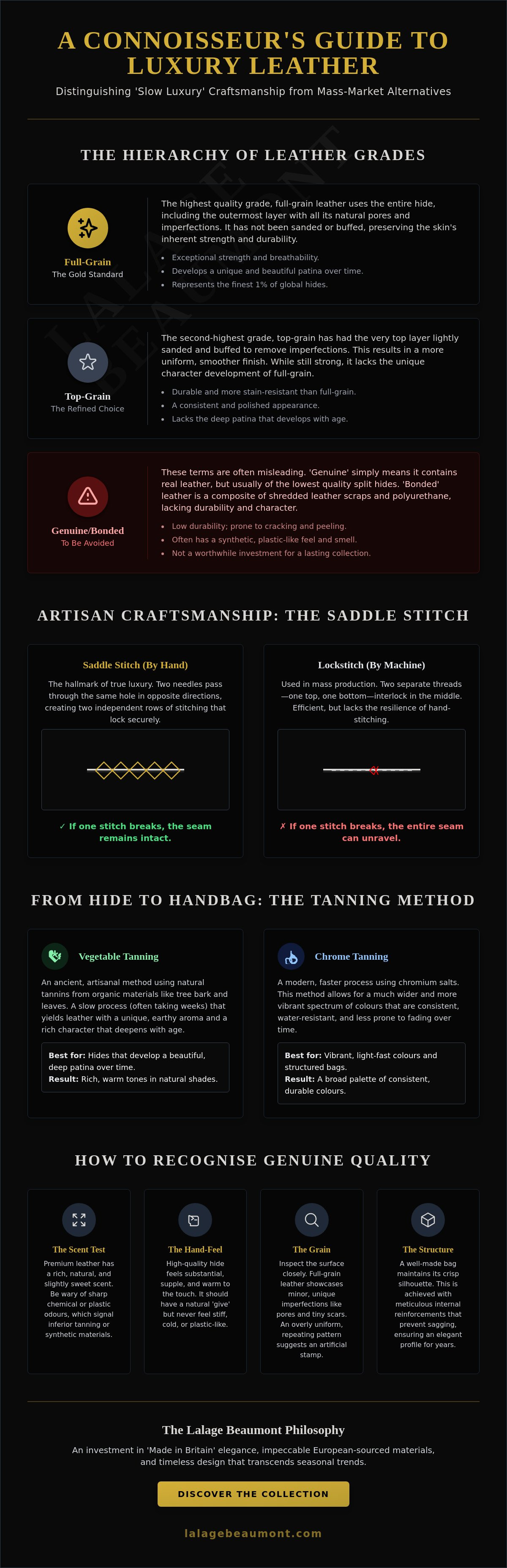
Understanding the grade of your leather is the first step in making an informed purchase. Full-grain leather is the undisputed gold standard because it utilises the entire thickness of the hide, including the durable outer layer. It hasn't been sanded or buffed to remove natural marks, meaning it retains the strength and breathability of the skin. Top-grain leather offers a slightly more uniform appearance, as the very top layer is lightly refined; it remains durable but lacks the same depth of patina that develops with age. We suggest avoiding "genuine" or "bonded" leather. These terms are often misleading; "genuine" simply means the product contains some leather, often of the lowest quality, whilst bonded leather is essentially a composite of scraps held together by polyurethane.
The Aesthetic of Structured Luxury
A hallmark of British elegance is the ability of a bag to maintain a crisp, formal silhouette whilst remaining wonderfully supple to the touch. This balance is achieved through meticulous internal reinforcements. High-end construction involves layers of fine canvas or light bonded materials hidden between the leather and the lining, ensuring the piece doesn't sag even after years of use. When you visit a boutique, pay attention to the "hand-feel". Premium bovine and calf leathers should feel substantial but never stiff. They possess a natural warmth and a subtle, earthy scent that synthetic alternatives simply cannot replicate. This tactile quality is what distinguishes an heirloom from a temporary accessory, ensuring your luxury leather goods remain a staple of your wardrobe for many seasons.
The Journey from Hide to Handbag: Tanning and Sourcing
The creation of luxury leather goods begins long before a needle touches the hide. It starts in the historic tanneries of Europe, primarily in Italy, France, and Spain, where the water quality and traditional expertise remain unmatched. Selecting the right tannery isn't just about aesthetics; it's about ensuring the material meets the rigorous OEKO-TEX® 2026 standards that came into full effect on 1st June. These standards guarantee that the tanning process adheres to strict hazardous substance controls, aligning with the latest EU REACH regulations. When we select hides for our collections, we look for tanneries that balance heritage techniques with modern environmental responsibility.
The tanning method dictates the final colour saturation and the tactile response of the material. For structured handbags that must retain their architectural shape, we often favour bovine hides for their inherent strength. Conversely, calf leather is prized for its fine grain and velvety softness, making it the perfect choice for pieces that sit closer to the body. Each hide is selected with a specific silhouette in mind, ensuring the natural characteristics of the skin complement the intended design.
Vegetable Tanning vs. Chrome Tanning
The choice of tanning method profoundly influences the final personality of the leather. Vegetable tanning is an artisanal process using natural tannins found in bark and leaves. It's a slow luxury, often taking weeks to complete, but the result is a material that develops a beautiful patina over time. For more vibrant, contemporary shades, chrome tanning is often the preferred choice. It allows for a broader spectrum of colours that remain consistent and light-fast, which is essential for matching an outfit for high-society events like Royal Ascot. Many of the finest luxury houses utilise a combination of these methods to achieve both structural integrity and a flawless finish.
Sourcing for Longevity and Ethics
Quality begins with the life of the animal. Premium hides come from cattle raised in cool climates where insects are fewer, resulting in a surface free from bites or scars. Traceability has become a cornerstone of the industry, particularly following the European Commission's decision on 30th April 2026 to exclude leather from certain anti-deforestation laws. This change has placed the onus of proof on brands to maintain their own high standards through private mapping. We're delighted to work with partners who prioritise ethical procurement, ensuring that every hide is a byproduct of the food industry. If you're looking for a piece that embodies this commitment to quality, you might explore our latest handbag arrivals to see these materials in their finished form.
Hardware and Finishing Touches
The excellence of a piece is often revealed in its smallest details, particularly the hardware and edge finishing. We select only high-grade metals for our clasps, zips, and feet, ensuring they possess a reassuring weight and a precise "click" upon closing. Every exposed edge of the leather undergoes a meticulous multi-layer painting process. This involves applying a base coat, sanding it smooth, and repeating the application up to six times until the edge is perfectly sealed. This prevents moisture from entering the leather fibres and provides a clean, sophisticated finish that complements the overall aesthetic. When you handle a bag in one of our boutiques, you'll notice the resistance in the zip and the balance of the hardware, all of which signal a product built to endure for generations.
How to Spot Genuine Quality in Luxury Leather Goods
When you step into a London boutique, the first indicator of quality isn't visual; it's olfactory. Genuine luxury leather goods possess a rich, earthy aroma that's both subtle and unmistakable. If an item smells of sharp chemicals or plastic, it's likely been treated with heavy synthetic finishes to mask inferior hide quality. Beyond the scent, look closely at the surface under good lighting. True full-grain leather exhibits tiny, irregular pores. If the grain pattern appears too uniform or repeats perfectly every few centimetres, you're likely looking at a stamped "corrected" grain rather than the natural skin.
The weight of a piece also tells a story. A premium handbag should feel substantial due to the quality of the hide and the meticulous internal reinforcements, yet it must remain perfectly balanced when worn. Pay close attention to the lining. Whilst mass-market brands often cut costs with polyester or nylon interiors, a hallmark of true luxury is a lining made from sumptuous suede or silk. These materials don't just feel better; they're more durable and kinder to your belongings, ensuring the interior remains as beautiful as the exterior over years of use.
The Detail Checklist for Buyers
Before making your investment, we suggest running through this brief inspection to ensure the craftsmanship meets your expectations:
- Inspect the stitching: Are the stitches consistent and angled slightly? This is often a sign of hand-finishing that provides superior strength.
- Test the zips: A luxury zip should move with a smooth, heavy resistance. It shouldn't feel "tinny" or catch on the lining fabric.
- Check for colour fastness: The leather shouldn't feel oily to the touch, and the colour should never "bleed" or transfer onto your skin or clothing.
- Examine the edges: Look for the 6 layers of hand-painted sealant mentioned previously; the edge should be smooth and slightly raised, never cracked or peeling.
Evaluating the Brand’s Aftercare
A brand’s commitment to its products shouldn't end at the point of sale. Longevity is a pillar of sustainability, and reputable houses like Lalage Beaumont, which celebrated its 20th anniversary in 2024, offer comprehensive repairs and alterations to ensure your piece remains in pristine condition. Always ask about storage; a quality item should always be accompanied by a breathable cotton dust bag to protect it from light and moisture. For those looking to maintain their collection at home, Handbag Care 101: Keeping Your Leather Pristine offers essential advice on preserving the natural oils of the hide. If you're ready to find a piece that meets every one of these quality markers, we would be delighted to help you select a handcrafted leather bag from our latest collection.
The Lalage Beaumont Philosophy: British Elegance and Heritage
Lalage Beaumont is built on a foundation of traditional London tailoring and a steadfast commitment to the "Made in Britain" seal. Since celebrating our 20th anniversary in 2024, we've continued to champion the unhurried precision of local craftsmanship. Our boutiques in Knightsbridge and the historic Burlington Arcade serve as centres of excellence for luxury leather goods, where the focus remains entirely on the individual. We take a "Refined Hostess" approach to service. This means we aren't just selling accessories, but assisting you in curating a wardrobe that reflects your personal grace and the demands of your professional life. We believe that true luxury is found in the personal connection between the maker, the curator, and the client.
Curating a Wardrobe for the Social Season
British design often favours structured silhouettes for formal events because they convey a sense of poise that softer shapes lack. This is particularly evident when matching luxury leather goods with our collection of occasion hats for the highlights of the social calendar. For instance, the Odette Handbag has become a favourite for Royal Ascot and summer weddings due to its architectural integrity and the curated palette of colours designed to complement our seasonal womenswear. We carefully select each shade to ensure it coordinates with the specific silks and wools used in our clothing collections. Whether you're attending a garden party or a high-society wedding, a structured bag provides a polished finish that remains timeless and elegant across every season.
The Boutique Experience: From Online to In-Person
While digital browsing offers convenience, there's no substitute for the sensory experience of a London boutique. Feeling the weight of the hide and seeing the depth of the colour in person allows you to appreciate the nuances of the grain we've discussed. Our boutiques offer more than just ready-to-wear collections. Our made-to-measure services ensure that your entire ensemble, from a tailored coat to a leather accessory, is perfectly synchronised. This level of personalisation is rare in a world of mass production, but it's central to our philosophy of longevity and quality. If you would like some assistance in selecting a piece for a specific event or simply wish to explore our heritage designs, we would be delighted to welcome you. Our team is here to help you find an investment piece that you'll cherish for a lifetime.
Investing in a Legacy of Craftsmanship
Choosing the right piece involves looking beyond the label to the technical mastery of the artisan. It's about longevity. We've explored how the unhurried precision of the saddle stitch and the integrity of full-grain hides distinguish luxury leather goods from the transient nature of fast fashion. By understanding the rigorous OEKO-TEX® 2026 standards and the importance of multi-layer edge painting, you can now build a collection with the discernment of a true connoisseur.
Our commitment to these traditional values remains at the heart of everything we do. Each piece is handcrafted in Spain and Italy by master artisans, blending award-winning design influences with the timeless needs of the British social calendar. We would be delighted to welcome you to our boutiques in the heart of London’s Knightsbridge to experience this quality first-hand. If you're ready to find a piece that combines heritage with modern elegance, we invite you to explore our collection of handcrafted leather handbags. We look forward to helping you select a companion that will gain character and beauty with every passing year.
Frequently Asked Questions
What is the best type of leather for a luxury handbag?
Full-grain calf leather is widely considered the best for its combination of durability and refined texture. It retains the natural strength of the hide whilst offering a velvety hand-feel that mass-market alternatives lack. This material ensures the bag remains a staple for decades. It's the preferred choice for those who value a material that breathes and ages with grace.
How can I tell if a leather bag is truly handcrafted?
Look for the subtle, rhythmic slant of the stitches, which indicates a traditional saddle stitch performed by hand. Machine stitches are perfectly straight and uniform, whereas manual work exhibits slight, charming irregularities. Additionally, check the edge painting; a handcrafted piece will have multiple smooth layers of sealant rather than a single, thin coat. These details are the signatures of a master artisan.
Is full-grain leather better than top-grain leather?
Full-grain leather is superior for longevity because it includes the strongest outer layer of the hide. Unlike top-grain leather, which is sanded to remove imperfections, full-grain retains its natural pores and develops a richer patina over time. It's the preferred choice for investment pieces that need to withstand daily use. Top-grain is often used when a more uniform, flawless appearance is required.
How do I care for my luxury leather goods in the British weather?
Protect your items by applying a high-quality leather cream every six months to maintain the hide's natural oils. If your bag gets caught in the rain, wipe it immediately with a soft, dry cloth and let it dry naturally away from direct heat. Proper maintenance is essential for preserving the integrity of luxury leather goods in damp climates. Consistency is the key to preventing the leather from drying out.
Why are handcrafted leather bags more expensive than designer brands?
The cost reflects the hundreds of hours required for manual assembly rather than the marketing budget of a global logo. A master artisan might spend 40 hours on a single bag, ensuring every stitch is self-locking and every reinforcement is perfectly placed. You're paying for the skill of the maker and the quality of the raw material. This artisanal focus ensures a level of durability that mass production cannot match.
What should I look for in a leather wallet for a gift?
Prioritise the "turn-back" edges and the quality of the internal lining. A well-made wallet should have leather-lined pockets rather than fabric ones, which tend to tear over time. Ensure the corners are neatly finished; this attention to detail signals a piece that will be used and cherished for years. A gift of this quality reflects a deep appreciation for traditional British standards of excellence.
Does luxury leather always develop a patina?
Only full-grain and vegetable-tanned leathers develop a significant patina, which is the characteristic sheen that comes with age. Chrome-tanned leathers, often used for vibrant occasion wear, are designed to maintain their original colour and finish. Both are hallmarks of quality, but they serve different aesthetic purposes in a collection. Your choice should depend on whether you prefer a changing character or a consistent look.
How do I store my leather bags to prevent them from losing their shape?
Stuff your bags with acid-free tissue paper or a dedicated bag pillow to support the internal structure when not in use. Always store them upright in their original breathable cotton dust bags. Avoid hanging them by the handles, as this can stretch the leather and compromise the silhouette of your luxury leather goods. Storing them in a cool, dry place ensures they remain in boutique condition for the next social season.